This article is general information, not medical advice. If pain is severe, lasting or getting worse, talk to a doctor. Read our health disclaimer.
Do you need perfect posture all day? No. NIOSH guidance reviewed in 2024 says awkward posture can raise musculoskeletal risk, but it also says holding the same position for a long time can cause muscle fatigue and disrupt blood flow even when that position is neutral. A useful workstation supports comfortable, neutral positions while still letting you change position and task.
Do You Need Perfect Posture All Day? What the Evidence Says
The myth starts with a real idea: some positions place more demand on the body than others. NIOSH’s 2024 ergonomics risk-factor guidance distinguishes neutral, awkward and static postures. Neutral posture reduces unnecessary strain, while awkward positions can require more effort from muscles, tendons, nerves and joints.
However, NIOSH adds an important limit. Maintaining the same position for an extended period can produce muscle fatigue and interfere with blood flow even in a neutral position. The goal, then, is not to freeze your body in one photographically “correct” pose. A better target is a workstation that makes comfortable positions easy and movement possible. See the desk sitting posture guide for a neutral starting position without treating it as a pose you must hold.
NIOSH’s 2026 office guidance makes the same point: workers should not need to sit or stand for too long. Its work-from-home guidance also recommends varying posture regularly. So do you need perfect posture all day? The sources support comfortable starting positions plus variation, not one frozen pose. For practical changes, see the flexible setup guide and the guide to better breaks.

A Better Model: Neutral Enough, Supported and Changeable
Start by removing obvious mismatches. Keep frequently used controls within easy reach, support the feet, and place the keyboard and mouse so the wrists can stay close to neutral. The chair adjustment guide, keyboard and mouse guide and monitor-height guide cover those pieces separately.
- Use a comfortable neutral position as a starting point, not a posture you must hold without moving.
- Change position or activity before discomfort builds when your work allows it.
- Fix repeated reaching, twisting or unsupported positions instead of trying to “sit straighter” through them.
- Treat recurring symptoms as information about the task and setup, not as proof that your posture is morally good or bad.
This approach also avoids swapping one static position for another. Standing all day is not a solution to sitting all day; NIOSH’s review of prolonged standing found fatigue and discomfort with long static standing and highlighted movement as a common practical response. The standing-all-day article and sit-stand timing guide explain why there is no universal ratio.
| Myth | What the sources support | Better question |
|---|---|---|
| There is one perfect pose | NIOSH describes neutral posture, but static posture still matters | Can I work comfortably and change position? |
| Standing fixes sitting | Prolonged standing can also produce fatigue and discomfort | Can I alternate and move? |
| Pain proves bad posture | Symptoms can have many causes and need context | Does a task or position repeatedly trigger symptoms? |

Do You Need Perfect Posture All Day? What to Do Instead
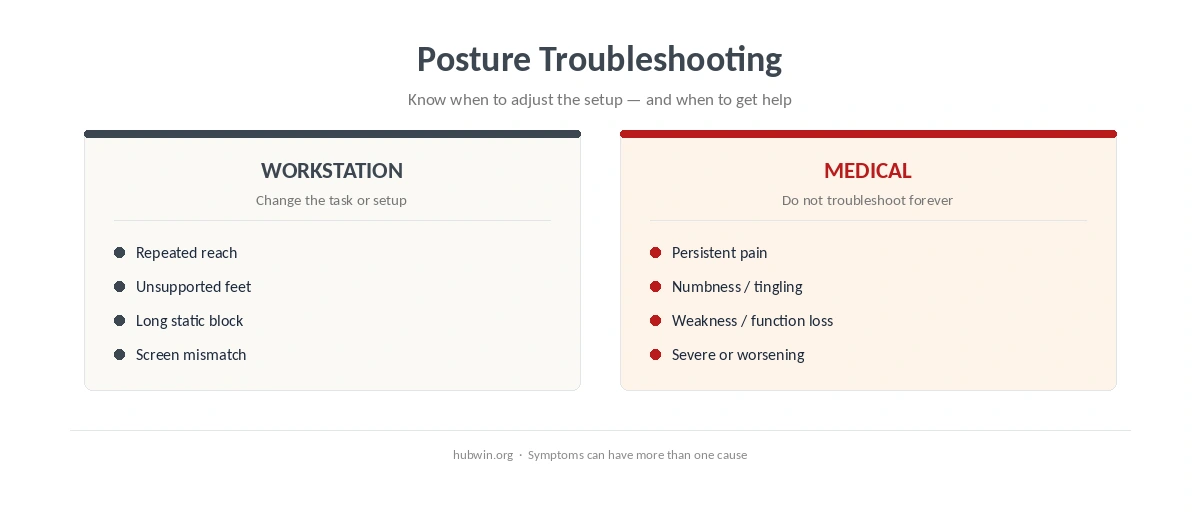
If you keep asking do you need perfect posture all day, replace the question with a short check: Is the screen forcing you to crane forward? Are the shoulders lifted to reach the keyboard? Are the feet unsupported? Have you stayed still for a long block? The daily posture checklist and home-office ergonomics checklist turn those questions into observable checks.
If one setup worked before and now feels wrong, do not assume you have “forgotten” good posture. Workload, equipment, task mix and time spent in one position can change. The setup reassessment guide helps separate a changed task from a changed workstation. The daily body check-in shows how to record timing and location without self-diagnosing.
When Posture Symptoms Need Medical Help
Posture advice should not become a reason to ignore persistent symptoms. NIOSH’s 2024 program guidance says complaints such as localized muscle fatigue, discomfort or pain that does not go away after rest deserve follow-up. Numbness, tingling, weakness, loss of function, pain after a significant injury, or symptoms that are severe or getting worse also belong with a clinician rather than another posture experiment. For symptom-specific warning signs, use the desk-setup symptom guide and health checklist.
How We Research
HubWin reviewed NIOSH’s ergonomics risk-factor guidance, reviewed March 2024; NIOSH’s office-environment guidance, reviewed July 16, 2026; and NIOSH’s 2020 work-from-home guidance on posture variation and breaks. We checked these sources on October 9, 2026. We use “neutral posture” as a lower-demand starting position, not as a promise that one pose prevents pain. Learn how HubWin researches articles.
FAQ
No. NIOSH says even a neutral position can become fatiguing when held for an extended period, so support and posture variation both matter.
The sources used here do not support treating one brief posture as automatic injury. Risk depends on factors such as posture, duration, repetition, task demands and individual circumstances.
Use a comfortable supported position and correct obvious workstation mismatches, but do not turn posture into a rigid pose you hold continuously.
Not automatically. Prolonged static standing can also produce fatigue and discomfort. Alternating positions and moving are more consistent with NIOSH guidance.
Persistent, worsening, neurological or function-limiting symptoms deserve medical assessment rather than repeated workstation experiments.
The Bottom Line
So, do you need perfect posture all day? No. Use neutral, supported positions as a starting point, reduce repeated awkward reaches, and make room for movement and task changes. The chair-and-posture myth article and long-term desk-risk article add context without promising that one chair or one pose controls every symptom.