
This article is general information, not medical advice. If pain is severe, lasting or getting worse, talk to a doctor. Read our health disclaimer.
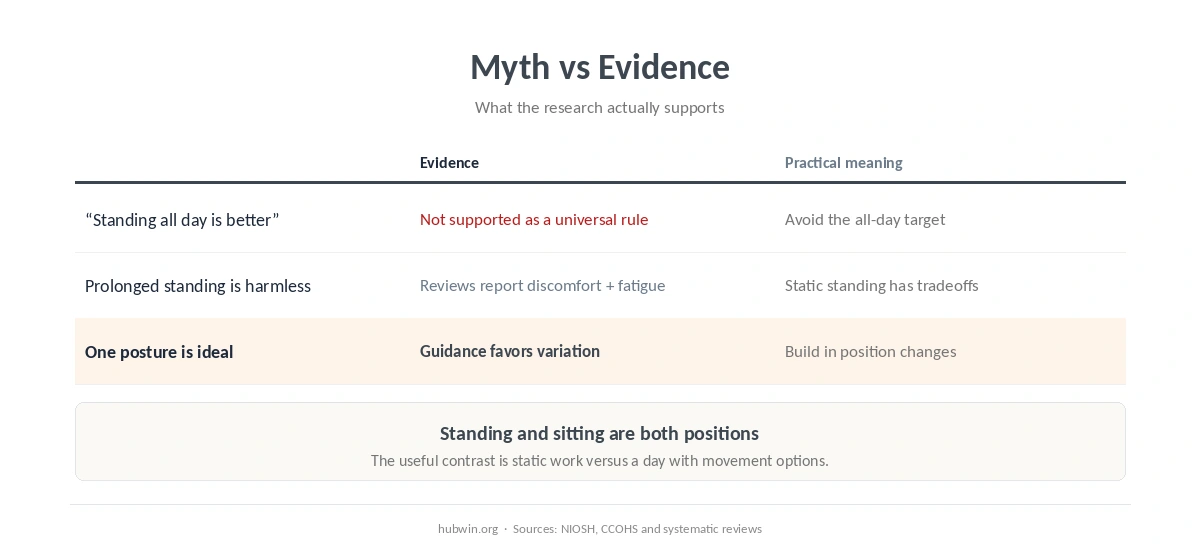
Standing all day is not automatically better than sitting all day. NIOSH’s review of prolonged standing reported links with low-back discomfort, physical fatigue, muscle pain and leg symptoms, while a 2020 systematic review found that prolonged standing at a desk did not produce significantly less perceived low-back pain than prolonged sitting in the pooled studies. The practical goal is not to replace one static posture with another. Read the NIOSH review summary. For that related claim, see the evidence on anti-fatigue standing mats.
Standing All Day Is Not the Opposite of Sitting Too Much
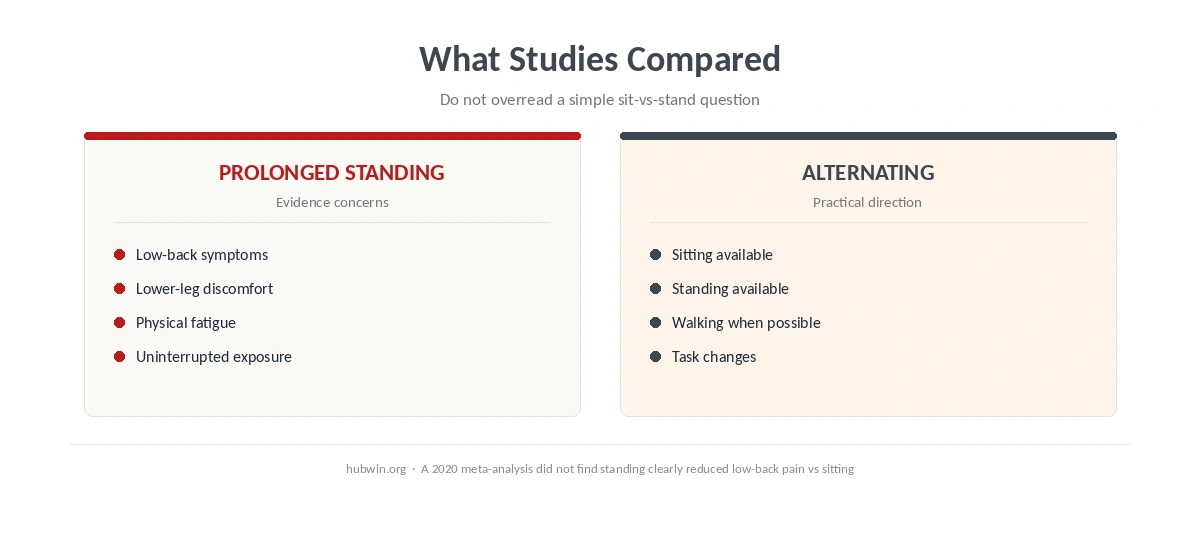
The phrase “standing is better” hides an important detail: movement and position changes are different from simply staying upright. NIOSH concluded that dynamic movement appeared to be the most useful direction across the prolonged-standing literature it reviewed. It also emphasized work designs that let people shift among sitting, standing, leaning and walking rather than locking them into one posture.
That fits CCOHS guidance for sitting work, which recommends avoiding static positions and designing tasks so workers can alternate positions frequently. In other words, standing all day does not solve the basic problem of being static for long stretches. See the CCOHS guidance.
What Research on Standing All Day Actually Found
A 2017 systematic review of laboratory studies linked prolonged uninterrupted standing with low-back and lower-extremity symptoms. The authors also noted that exposure limits and mechanisms were not fully understood. A separate 2020 systematic review and meta-analysis pooled three desk-work studies and found no significant reduction in perceived low-back pain from prolonged standing compared with sitting. These studies do not prove that standing desks are harmful; they show why “more standing” is too simple a target. Read the 2017 review.
Our standing desk myths guide looks at the wider evidence around sit-stand desks. This article answers the narrower question: whether you should aim to stand all day. The evidence does not support that as a universal goal.
If You Use a Standing Desk, Build in Position Changes
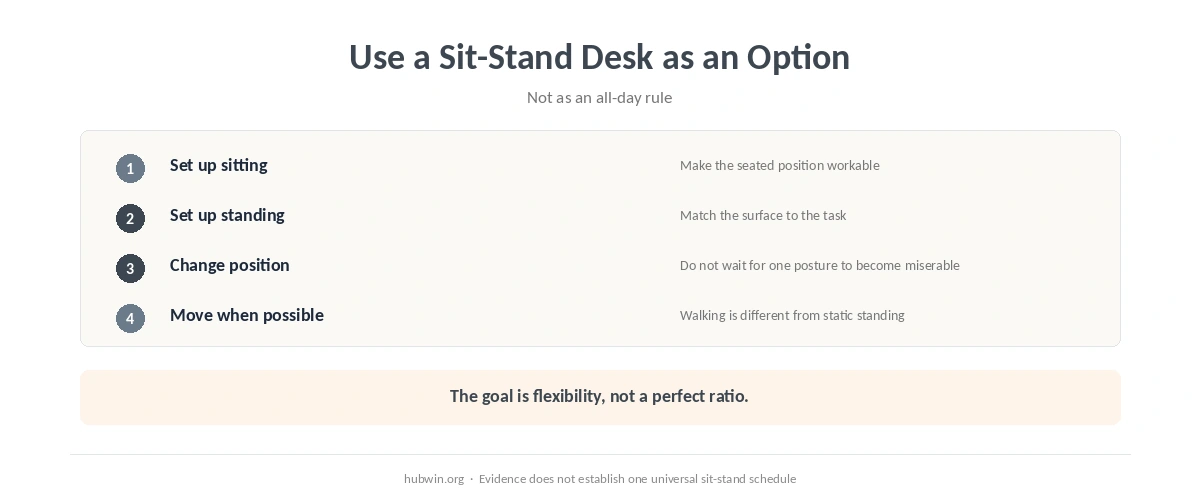
If you are standing all day because a desk can rise, use that feature as another available position rather than a rule. Adjust the surface to the task, then move when the current position starts to feel stale or uncomfortable. The standing desk height guide explains how to set the work surface around elbow height, while the sitting posture guide covers the seated side of the setup.
A good workstation should make both modes workable. Simple ergonomic changes covers low-cost ways to reduce obvious constraints, and the microbreak guide explains why a break can simply mean changing activity or position. If lower-back symptoms are already part of the picture, see our evidence-based lower-back guide rather than treating standing as a medical solution.
When Standing Discomfort Needs More Than a Desk Adjustment
Do not manage persistent, severe or worsening pain as a standing-desk experiment. A workstation can change exposure to static posture, but it cannot identify the medical cause of symptoms. If symptoms include weakness, numbness, swelling, major injury or other concerning changes, seek appropriate medical advice rather than continuing to troubleshoot the desk.
If the problem seems to be the chair instead, the chair adjustment guide walks through the main controls. The broader lesson is the same in both positions: support the task and keep the body free to change position.
Related: If that is the part of the setup you are working on next, continue with our sit-stand transition guide.
How We Research
HubWin treats standing-desk claims as health-adjacent YMYL content. The source set includes the NIOSH review on prolonged standing, current CCOHS posture guidance, the 2017 systematic review of prolonged-standing symptoms and the 2020 systematic review comparing prolonged standing with sitting during desk work. HubWin checked these sources on October 8, 2026. The article reports associations and study limits instead of claiming one posture prevents pain. Learn how HubWin researches articles.
FAQ
The evidence does not support a simple all-day standing rule. Prolonged standing also has documented discomfort and fatigue concerns, so position changes are the more defensible goal.
No universal schedule fits everyone. Use standing as one option and change position when the task and your comfort allow.
A standing desk is not a treatment. It changes your working position, and prolonged standing can also be uncomfortable for some people.
No. The point is not to forbid sitting. Ergonomics guidance emphasizes support, task fit and changing position rather than one permanent posture.
The sources used here do not establish one universal ratio. Avoid turning an uncertain evidence base into a precise schedule.
The Bottom Line
Standing all day is not a better default than sitting all day. Use sitting and standing as options, add movement when you can, and avoid turning either posture into an all-day rule. If symptoms persist or worsen, treat that as a health question rather than a desk-setting problem.