This article is general information, not medical advice. If pain is severe, lasting or getting worse, talk to a doctor. Read our health disclaimer.
If you are deciding how to use microbreaks, do not start with a rigid countdown. HSE guidance from 2025 says there is no universal legal interval for display-screen breaks. Instead, it favors short breaks often and gives 5 to 10 minutes every hour as an example. NIOSH 2020 and a 2018 Cochrane review also support breaking up long desk periods, although they studied different outcomes.
Microbreaks: How Often Should You Move?
HSE’s 2025 guidance gives the clearest practical answer. It says break timing depends on the work, and short breaks often are better than longer breaks less often. For example, HSE compares 5 to 10 minutes every hour with 20 minutes every 2 hours and prefers the shorter, more frequent pattern. For that related comfort question, see brain fog.
However, that HSE example is not a universal prescription. The same page says a break can be a change of activity rather than complete rest. It also says the change should let you get up, move around, stretch, or at least change posture.
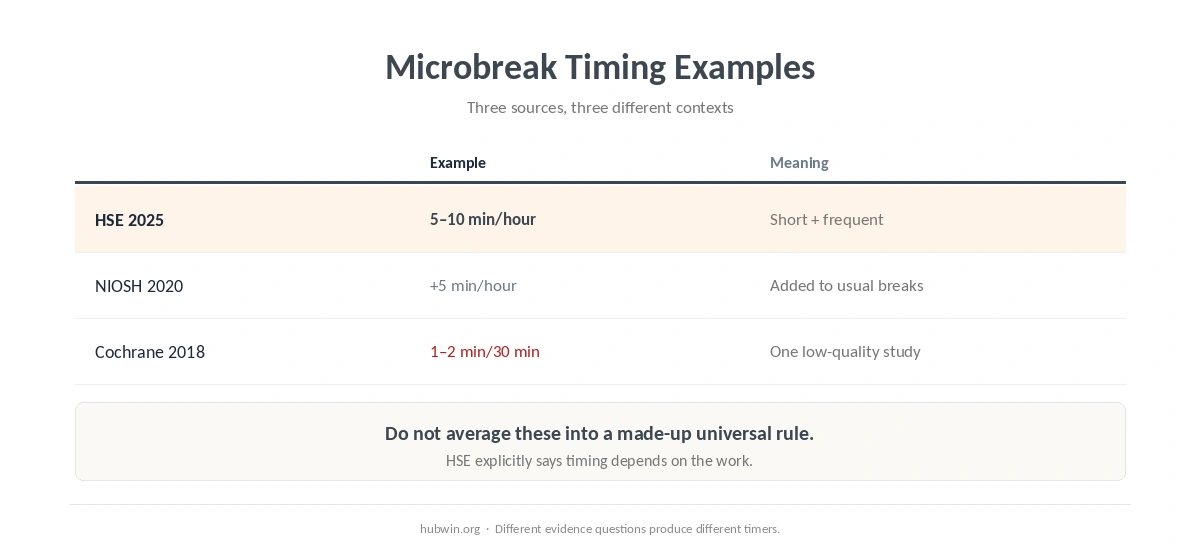
Microbreaks From NIOSH and Cochrane Use Different Timers
NIOSH’s 2020 home-work guidance describes research in which workers kept their usual twice-daily rest breaks and added an hourly 5-minute break. NIOSH reports lower overall musculoskeletal discomfort and eye strain with that added pattern. Therefore, this finding supports frequent interruption of desk work, but it does not prove that every worker needs exactly five minutes each hour. If symptoms are the main concern, see our guide on neck stretches.
A 2018 Cochrane review looked at workplace strategies for reducing sitting. In one low-quality study, breaks of 1 to 2 minutes every half hour reduced workplace sitting by about 40 minutes per day compared with two 15-minute breaks. Importantly, that result measures sitting time. It does not establish a best interval for pain relief or productivity. For the workflow side of this, see Pomodoro Technique.
| Source | Timing example | What it actually means |
|---|---|---|
| HSE 2025 | 5–10 minutes every hour | An example of short, frequent DSE breaks; no universal legal interval |
| NIOSH 2020 | Added 5-minute break each hour | NIOSH research summary reported less overall discomfort and eye strain |
| Cochrane 2018 | 1–2 minutes every 30 minutes | One low-quality study reduced sitting time versus two 15-minute breaks |
Use Microbreaks as a Work Pattern, Not a Productivity Promise
A useful routine starts with natural stopping points. Microbreaks can use those stopping points instead of interrupting every task at an arbitrary second. For example, stand after a call, walk when you refill water, or switch from screen work to a task that changes posture. This follows HSE 2025 because the regulator explicitly allows changes of activity to function as breaks. If symptoms are the main concern, see our guide on video call fatigue.
Next, notice whether your workday has long blocks with no change at all. If it does, a reminder can help create a repeatable cue. HSE 2025 says break-monitoring software can remind users, but it still places responsibility on proper work planning rather than on the app itself.

A Simple Microbreak Routine for Desk Work
- Start with the work pattern. HSE (2025) says frequency depends on the type of work, so identify stretches of uninterrupted screen use first.
- Prefer shorter changes more often. HSE (2025) gives 5–10 minutes each hour as an example, not a universal rule.
- Let the break change your posture. HSE (2025) says breaks or task changes should allow movement, stretching, or a posture change.
- Use reminders only when needed. HSE (2025) accepts break-monitoring software as a prompt, while still emphasizing work design.
- Keep the evidence in proportion. Cochrane (2018) found a sitting-time benefit from very short frequent breaks in one low-quality study, not a reliable health or productivity result.
If you also want to check the workstation itself, use the home office ergonomics checklist. Movement cannot compensate for a screen, chair, or keyboard that stays badly positioned all day. For a related evidence check, see walking pad.

Related: If that is the part of the setup you are working on next, continue with our 10-change comfort guide.
How We Research
HubWin checked HSE work-routine and break guidance, updated March 20, 2025. We also checked NIOSH home-work guidance posted November 20, 2020, and the 2018 Cochrane review of workplace sitting interventions. HubWin rechecked these sources on October 8, 2026. See About HubWin for our research method.
FAQ
Microbreaks are short interruptions to a work task. HSE (2025) treats both rest breaks and changes of activity as useful when they let a display-screen user move or change posture.
HSE (2025) does not set one universal interval. It favors short, frequent breaks and gives 5–10 minutes every hour as an example.
A Cochrane review (2018) found one low-quality study where 1–2 minute breaks every half hour reduced sitting time. That finding does not establish a universal health rule.
The sources used here do not justify a promise that microbreaks improve productivity. Their stronger findings concern work routine, sitting time, movement, discomfort, and eye strain. For a related evidence check, see sitting and mood.
Yes. HSE (2025) says a change of activity can serve as a DSE break when it lets you move, stretch, or change posture.
Bottom Line
Microbreaks are better treated as frequent changes in work and posture than as one perfect timer. HSE 2025 gives 5 to 10 minutes each hour as an example, while NIOSH 2020 and Cochrane 2018 use different schedules. Therefore, microbreaks should fit the task, create real movement, and avoid claims that one interval works for everyone. If symptoms are the main concern, see our guide on jaw tension.