
Learning how to work from home when you live with roommates is mostly a coordination problem, not a demand for everyone to stay silent all day. Shared homes need explicit rules for space, calls, noise and interruptions because the same room may serve different people at different times. NIOSH recommends finding a work-ready area where noise, lighting and temperature can be controlled as much as the home allows. A related how-to guide covers home office privacy.
How to Work From Home When You Live With Roommates: Start With Shared Rules
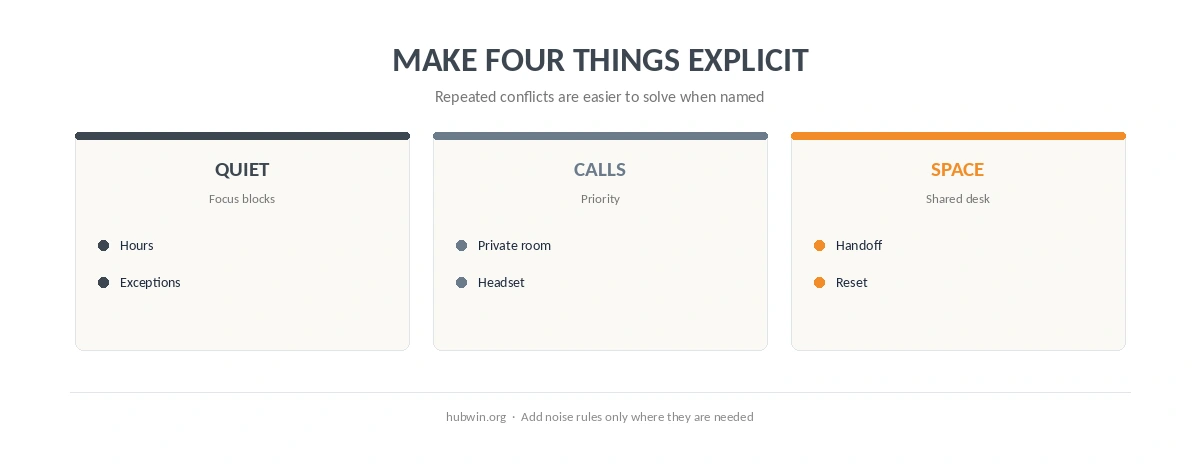
First, agree on the few situations that affect everyone: calls, quiet work, visitors, shared tables and high-noise chores. Put those constraints on a shared calendar or simple message thread instead of renegotiating them in the moment. The household-boundaries guide and shared-room guide offer templates you can adapt without assuming a family structure.
In practice, how to work from home when you live with roommates gets easier when the rules include exceptions. A quiet block can still allow urgent questions, deliveries, or agreed household needs. The interruption guide separates necessary interruptions from avoidable signals, while the home noise guide covers environmental changes.
How to Work From Home When You Live With Roommates in Limited Space
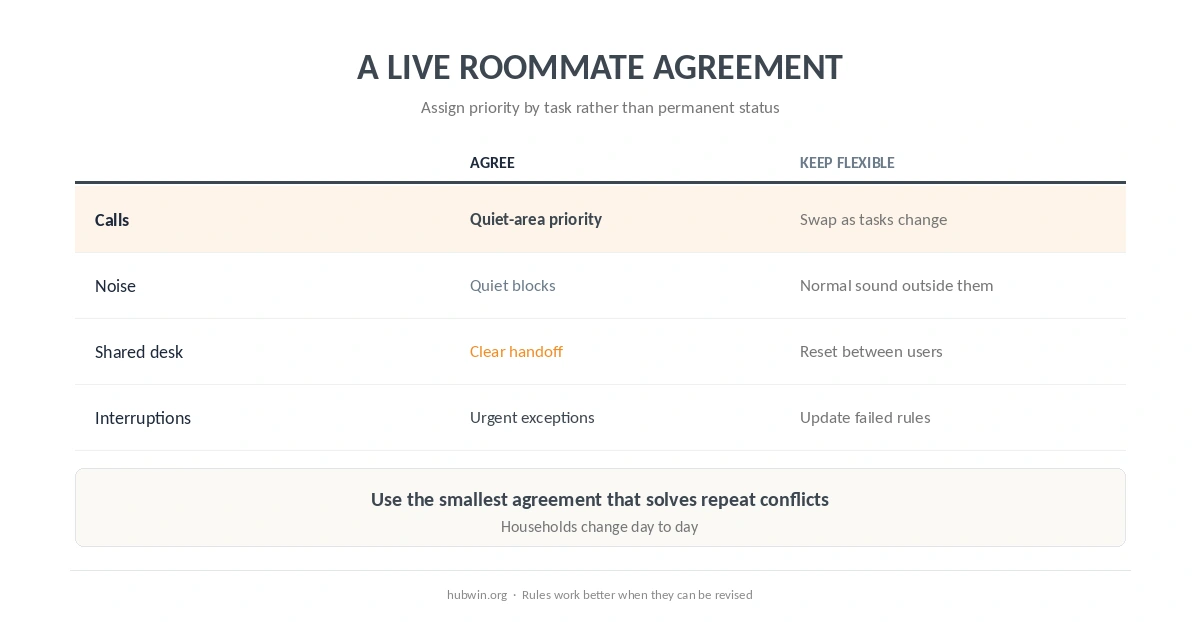
Next, assign priority by task rather than by person. Someone on a confidential call may need the quieter room for an hour, while another person can use the shared table for routine work. A qualitative study of 28 dual-income families in five countries found that households managed shared work by repurposing space, aligning schedules and maintaining live boundary agreements. That sample was families with children, not roommate households, so use the strategies as examples rather than universal rules.
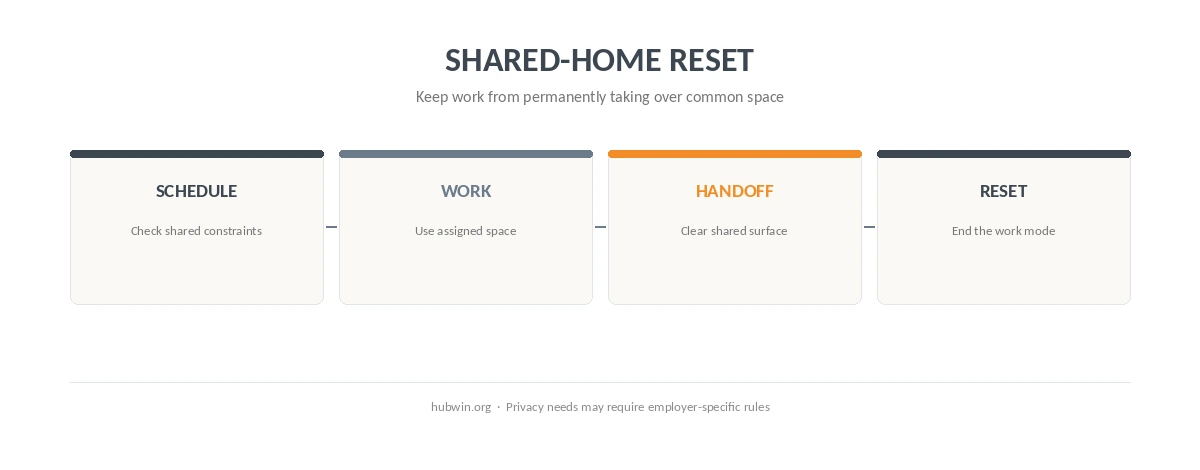
Also, how to work from home when you live with roommates may require time-sharing one surface. Keep each person’s setup easy to reset instead of letting the shared table become permanent storage. The flexible setup guide, daily tidy guide, and cable setup guide can reduce the friction of handoffs.
| Shared issue | Agreement to make | Keep flexible |
|---|---|---|
| Calls | Who gets the quietest area and when | Swap when the task changes |
| Noise | Quiet blocks and acceptable background sound | Use headphones only when practical |
| Shared desk | Clear handoff and reset rule | Store personal gear off the surface |
| Interruptions | Define urgent exceptions | Update the rule when it fails |
Protect Privacy Without Turning the Home Into an Office
For confidential calls, use headphones where appropriate, position the screen away from shared traffic, and choose the most private available location. However, do not assume headphones solve every privacy requirement; employer policy may set stronger rules. The professional video-call guide covers the physical setup, while the calm environment guide helps with background friction.
Finally, preserve an end to the workday. A shared home can blur work and nonwork boundaries because the workspace never fully disappears. A review of telework research describes boundary-management strategies ranging from strict separation to more integrated approaches, including shared rooms. The end-workday guide and work-life boundaries guide can help each roommate choose a workable level of separation.
How We Research
HubWin read NIOSH’s working-from-home guidance, a review of telework and worker well-being, and the qualitative study Who Moved My Boundary? on 28 dual-income households in five countries. We rechecked them on October 8, 2026. The household study involved families with school-age children, so this article uses its coordination strategies cautiously rather than treating them as roommate-specific evidence. Learn how HubWin researches articles.
FAQ
Agree on call priority, quiet blocks, desk handoffs and urgent exceptions. Revisit the rules when schedules change.
Use task needs rather than a permanent hierarchy. Confidential or high-focus work may justify temporary priority.
Not necessarily. Headphones can help with sound, but shared rules and task scheduling may solve problems without continuous headphone use.
Give each person a compact setup and a clear reset rule so the surface returns to a neutral state between users.
Make it more specific. Identify the repeated conflict—calls, noise, clutter, timing or interruptions—and change that rule rather than adding restrictions everywhere.
The Bottom Line
The useful answer to how to work from home when you live with roommates is to coordinate the shared constraints, not to impose office silence on the whole home. Agree on quiet periods, call priority, desk handoffs and urgent exceptions, then revise the arrangement when real life exposes a weak point. The apartment home-office guide can help when the main constraint is physical space.