To recover focus after interruption, rebuild the state of the task before trying to work at full speed. Reopen the relevant material, scan the last completed step, use any note or visual cue you left, and choose one concrete next action. The restart is easier when you do not force yourself to remember the entire task at once.
Prevention still matters. The guide to handling interruptions at home focuses on reducing avoidable disruptions. This article starts one step later: the interruption already happened, and you need a reliable way back into the work.
How to Recover Focus After an Interruption
Interruption research describes a resumption lag: people often need time to reestablish the suspended task after switching away. Experimental work has found that longer or more demanding interruptions can increase that restart cost. Other experiments found that contextual cues available before and after the interruption can make suspended goals easier to retrieve.
That is why the first move should be reconstruction, not self-criticism. If your workday already involves frequent switching, reducing unnecessary context switching lowers the restart count. When switching is unavoidable, a repeatable return sequence makes each restart less improvised.
Recover Focus After Interruption with a Return Cue
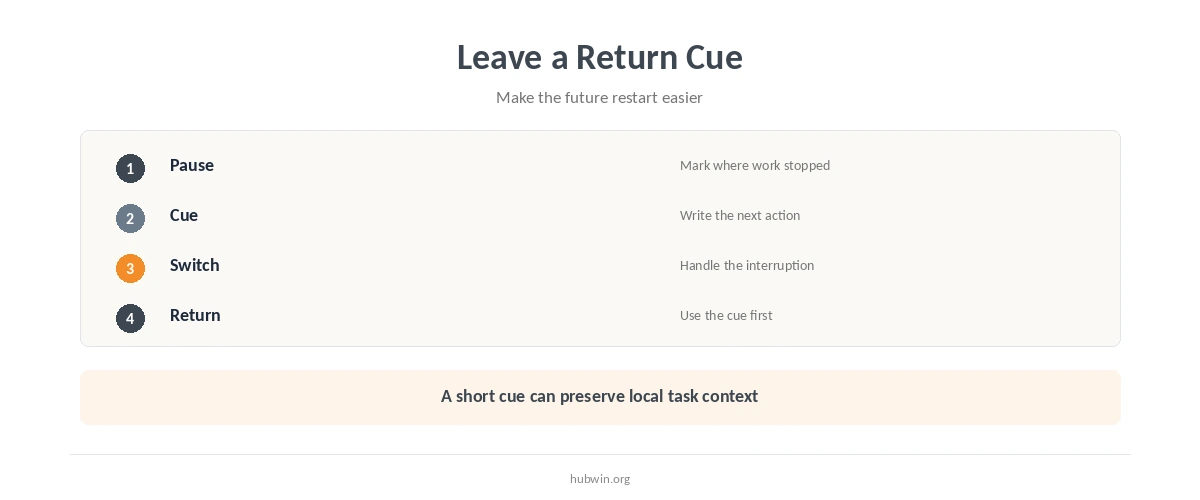
When you have even a few seconds before switching away, leave a cue for your future self. The cue should answer one question: what was I about to do next? It can be a short note, a highlighted line, an unfinished sentence with a comment, or a task checkbox that identifies the next operation.
- Pause at a visible boundary when possible. Finish the current small step or mark exactly where it stopped.
- Write the next action. Use a verb and an object, such as “compare the two totals” or “draft the conclusion paragraph.”
- Keep the relevant context open. Do not close every tab or document if you expect to return soon and leaving it open is safe.
- Handle the interruption. Give the new task the attention it actually requires instead of trying to hold both tasks in mind.
- Return through the cue. Read the note, scan the local context, and perform the next action before reorganizing the whole project.
For planned transitions between calls and concentrated work, switching between focus work and calls can create stronger boundaries. If a focused block is repeatedly broken by preventable requests, protect it with the ideas in protecting deep-work time.
Reconstruct Context Before You Replan the Project
After a longer interruption, the old cue may not be enough. Reconstruct the local state in layers. First identify the file, conversation, or document that represents the task. Then identify what has already been completed. Finally, identify the smallest next decision. This narrows the amount of information you need to reload. To recover focus after interruption, rebuild only the context required for the next action.
| Interruption | Useful return cue | First action |
|---|---|---|
| Quick household question | One-line next-step note | Resume the marked step |
| Unexpected call | Open task plus short status note | Scan what changed |
| Meeting between work blocks | Calendar note or task checkpoint | Reopen the active file |
| Long unplanned disruption | Brief written task state | Reconstruct before reprioritizing |
If the interruption changed the day, use time blocking or your daily schedule to decide where the displaced work goes. A weekly plan can hold work that no longer fits today. Do that after you know the task state. Replanning before reconstructing can turn a simple restart into a broad review of everything you could be doing.

Protect the First Minutes of the Restart
The first part of the return is vulnerable to another switch. Avoid opening inboxes, feeds, or unrelated task lists while you are rebuilding context. Start with the material that belongs to the interrupted task. Once you have completed one meaningful next action, decide whether the task still deserves the current block.
A fast desk-startup routine uses the same principle at a larger scale: reduce reconstruction before useful work can begin. During the day, managing distractions at home can protect the restart window from avoidable noise, notifications, and visual triggers.
Do Not Confuse a Restart with Instant Deep Focus
Returning to the correct task is not the same as immediately reaching your strongest concentration. The immediate goal is task resumption. Deeper focus can build after the context is stable again. Expecting an instant return to peak concentration can make a normal restart feel like failure. A repeatable cue helps you recover focus after interruption without demanding instant peak performance.
If your attention is generally lower later in the day, the guide to staying focused during an afternoon slump addresses that broader pattern. If the task itself needs long uninterrupted concentration, deep work at home gives it a larger scheduling structure. Breaks also matter; better work-from-home breaks are different from unplanned interruptions because they have a defined purpose and return point.

How We Research Interruption Recovery
HubWin treats interruption recovery as a task-resumption problem, not as a claim that every interruption causes the same amount of lost time. Laboratory research supports the existence of resumption costs, but the size depends on the task, interruption, person, and context. Research on contextual cues suggests that preserving information about the suspended goal can support the return.
Sources reviewed October 9, 2026 include the study of interruption duration, demand, and task resumption. We also checked experiments on contextual cues and interruption recovery. Finally, we reviewed work on individual differences and resumption lag. Read how HubWin researches articles.
Part of the difficulty is task resumption: the suspended goal and local context need to become active again. The cost varies with the interruption and the task.
Write the smallest useful return cue: what you just finished and the next concrete action. It should help you restart without rereading the whole project.
Not if the interrupted task still has priority. Rebuild that task first unless the interruption itself changed what is urgent.
Leave a clearer state note and place the task back into a trusted schedule or list. The goal is to preserve enough context for a later restart.
To recover focus after interruption, make the return smaller than the whole project. Reopen the task, restore the local context, follow the cue, and complete one next action. Then decide whether to continue, reschedule, or stop.