A midday reset routine is a short transition between the morning and the second half of the workday. Close or capture loose work, step away from the active task, check what changed, choose the next priority, and restart from one clear action. The routine should reduce clutter, not turn lunch into another planning meeting.
This is different from a quick-reset desk routine, which is mainly about restoring the workspace. A midday reset routine is a work-state reset: what is finished, what moved, what still matters, and what should begin next.
Midday Reset Routine: The Short Answer
A useful midday reset routine has two parts: recovery and reorientation. Research on micro-breaks suggests that short breaks can improve vigor and reduce fatigue on average, although overall performance gains were not consistent and more demanding tasks may need more recovery. Separate research on daily planning suggests that planning can support work engagement and performance, while frequent interruptions can weaken those benefits.
Keep the routine compatible with your daily work-from-home schedule. If the morning went roughly as planned, the reset can be brief. If priorities changed, use the reset to make one deliberate adjustment instead of letting the afternoon become a chain of reactions.

How to Build a Midday Reset Routine
- Stop at a boundary. Finish the current small step or write where to resume.
- Capture loose inputs. Move stray notes, messages, and remembered tasks into the system you already trust.
- Take a genuine break. Step away from the active work instead of using the entire pause to reorganize tasks.
- Review what changed. Check deadlines, completed work, and any new commitment that actually changes priority.
- Choose one next priority. Decide what deserves the first focused block after the reset.
- Write the first action. Make the restart concrete enough that you can begin without another planning round.
If you prefer a calendar view, time blocking at home can hold the revised afternoon plan. If you work from a task list, the work-from-home productivity checklist can help you keep the review small and operational.
Keep the Midday Reset Routine Smaller Than the Day
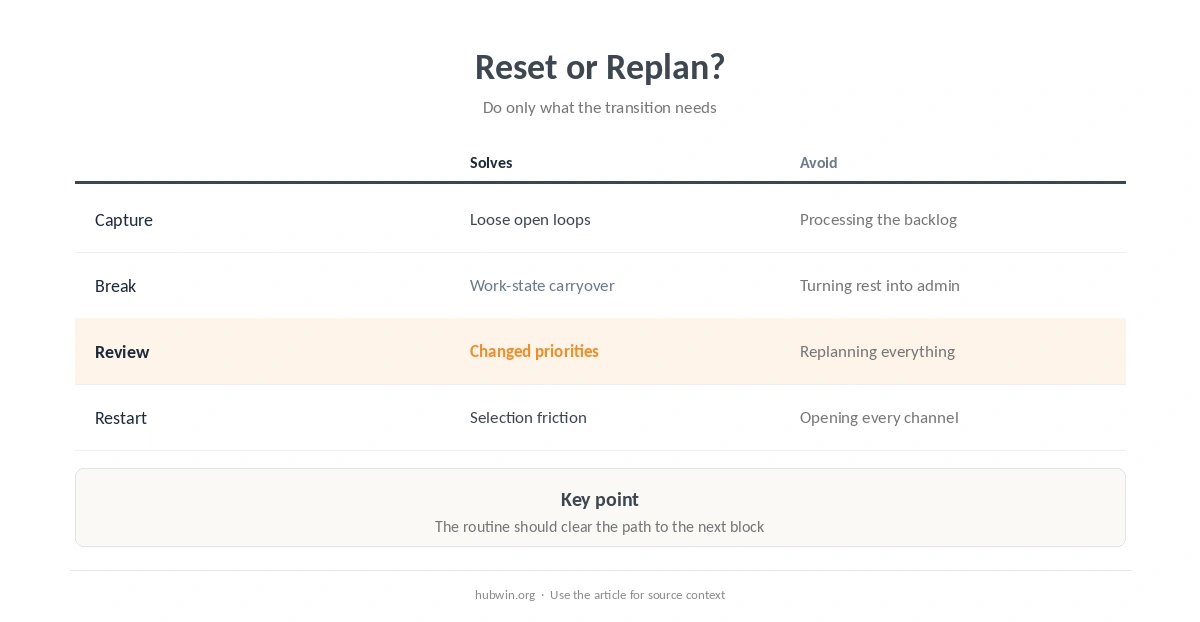
The reset is not the right time to rebuild your entire productivity system. Avoid reviewing every someday item, redesigning categories, or sorting a large backlog unless that work is itself the priority. The reset should answer a narrow question: given what happened this morning, what is the next useful block of work?
| Useful reset move | What it solves | What to avoid |
|---|---|---|
| Capture loose items | Stops mental rehearsal | Processing the entire backlog |
| Step away briefly | Creates a real transition | Turning the break into admin |
| Check changed priorities | Updates the afternoon | Replanning unchanged work |
| Choose one restart action | Reduces restart friction | Opening every communication channel |
If the real problem is constant incoming demands, use an interruption strategy and reduce context switching. A reset cannot compensate for a workday in which every notification gets immediate priority.
Use the Reset to Protect the Next Focus Block
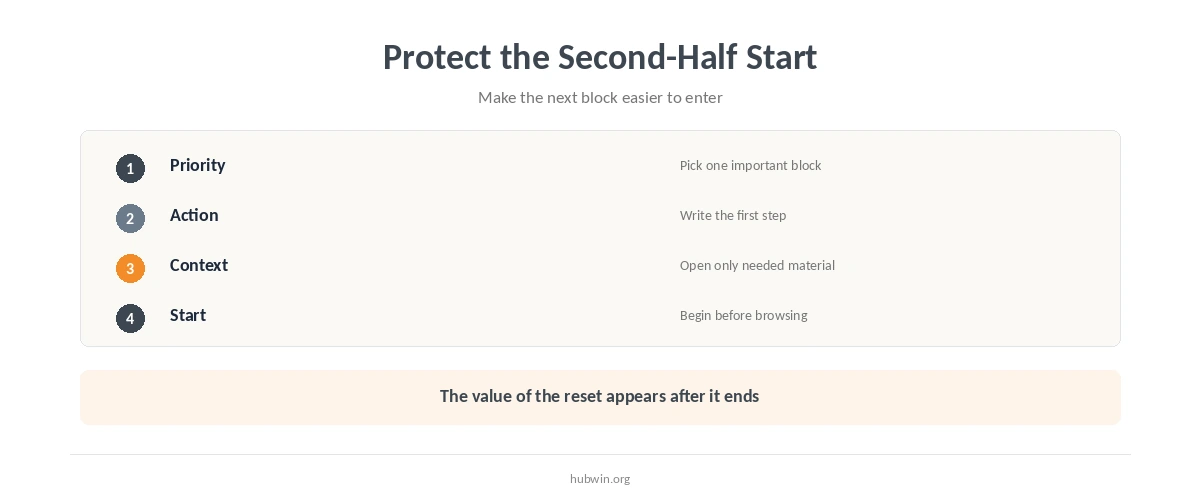
The value of the routine shows up after it ends. Close unrelated tabs, silence nonessential notifications, open the material for the chosen task, and start with the written next action. That protects the first part of the afternoon from another round of selection.
For concentration-heavy work, connect the reset to protected deep-work time. If the afternoon includes several calls, use a deliberate focus-to-call transition. If you simply need a lower-friction start, a faster desk startup applies the same principle to tools and workspace.
A Midday Reset Does Not Solve Every Afternoon Slump
A routine can organize the second half of the day, but it cannot guarantee high energy or concentration. If you regularly feel less alert in the afternoon, treat that as a separate pattern. Use the reset to choose work realistically, not to promise that a checklist will change how you feel.
The guide to staying focused during an afternoon slump covers that situation directly. Also keep better breaks in the schedule instead of expecting one midday pause to carry the whole day. If deep work is the priority, deep work at home explains how to give it a larger protected structure.
When to Skip or Shrink the Reset
You do not need a formal reset on every quiet day. If the morning ended cleanly, the next priority is obvious, and you already took a useful break, adding more review can become ceremony. Shrink the routine to a quick capture and restart. Conversely, a chaotic morning may need a slightly fuller review because commitments changed. Keep the routine proportional to the amount of uncertainty in the day. The test is simple: after the reset, do you know what matters next and can you begin it without reopening the whole plan? If yes, the reset has done enough.
How We Research Midday Work Resets
HubWin does not present this sequence as an official clinical, workplace, or research protocol. It is a HubWin editorial routine built from two research-supported ideas: breaks can support recovery, and planning can help organize work. The exact sequence and timing are editorial choices, not a prescription from the cited studies.
Sources reviewed October 9, 2026: Albulescu et al. systematic review and meta-analysis of micro-breaks, Ariga and Lleras on brief task breaks and vigilance, and Parke et al. on daily planning, engagement, interruptions, and performance. Read how HubWin researches articles.
There is no research-backed HubWin duration for this routine. Keep it short enough to remain a transition, and give the actual break enough space to feel separate from planning.
No. Lunch can be part of the break, but the reset also includes a brief work-state review before the next block.
Only if email is where important priority changes arrive. Avoid turning the reset into an open-ended inbox session.
Capture what changed, identify any true deadline shift, and create a smaller afternoon plan. Do not spend the whole reset defending the original schedule.
A midday reset routine should make the second half of the day easier to enter. Close the morning, take a real pause, update only what changed, pick one priority, and restart from a concrete next action.