
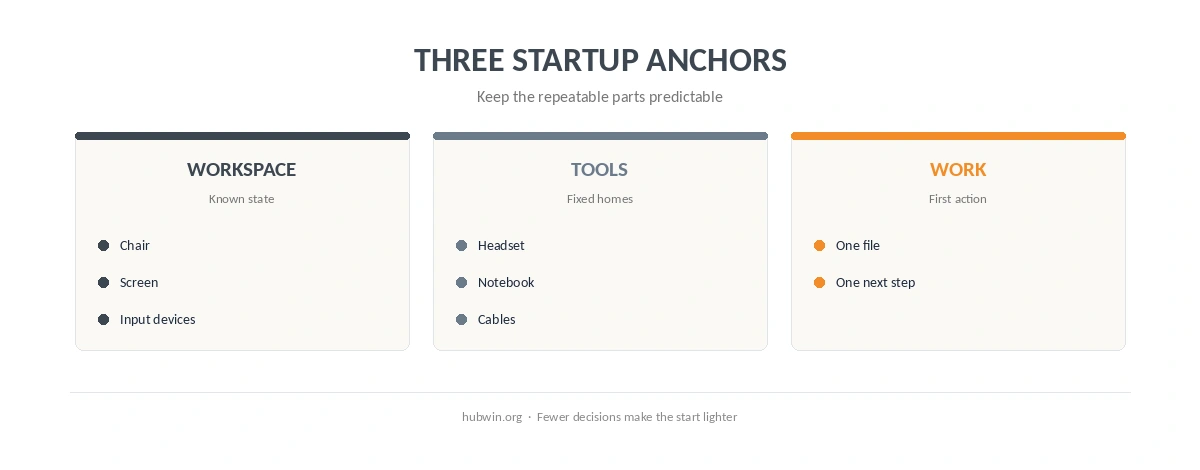
If you want to know how to make your desk setup faster to start each day, remove decisions that repeat every morning. Keep the workstation in a known state, put routine tools in fixed homes, and decide the first work action before you sit down. NIOSH’s 2020 home-work guidance recommends a dedicated work-ready environment, while a 2006 meta-analysis found that specific if–then plans can improve goal initiation across many behaviors.
How to Make Your Desk Setup Faster to Start Each Day
Start with the physical reset. The daily tidy routine and keep-only-what-you-use guide both reduce how many objects compete for the active work zone. The goal is not a showroom desk. It is a desk where the keyboard, mouse, screen and daily tools already have predictable places.
Then remove cable and device setup from the morning. If a cable must be found, a headset must be charged, or a camera has to be rebuilt every day, the system is asking you to solve the same problem repeatedly. The under-desk cable guide and video-call setup guide show how to leave recurring equipment ready without filling the surface.
How to Make Your Desk Setup Faster to Start Each Day With Fewer Decisions
Another part of how to make your desk setup faster to start each day is deciding the first action before the morning begins. The useful part of planning is specificity. Gollwitzer and Sheeran’s 2006 meta-analysis reviewed 94 independent tests of implementation intentions. These plans link a cue to an action: if situation Y occurs, then I will do X. For a desk startup, that can be as simple as “when I sit down, I open the project brief and write the next paragraph.” It is not proof that one morning ritual is best; it supports deciding the action in advance.
This is also why the work-from-home morning checklist stays short. A checklist that asks you to redesign the day before starting can become another delay. The productivity checklist is better used to remove predictable friction, not to create a new planning project.
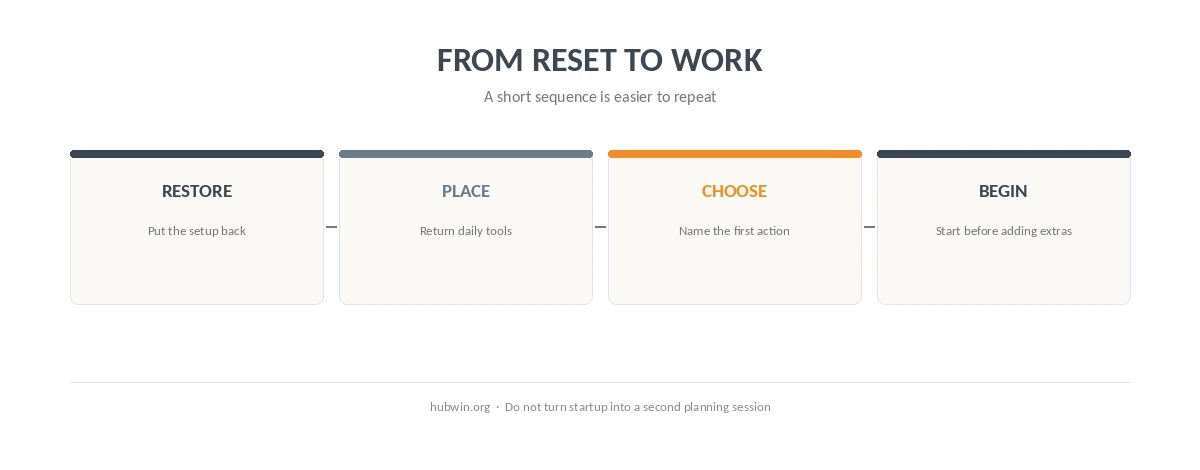
- Restore the chair, screen and input devices to their normal working positions.
- Return the few daily tools to fixed locations.
- Connect or place recurring call equipment before it becomes urgent.
- Write one clear first action for the next work block.
- Start the first task before adding optional cleanup or planning.
Use the Previous Workday to Make Tomorrow Easier
A third part of how to make your desk setup faster to start each day is leaving tomorrow a clean handoff. The fastest morning often starts the evening before. The end-of-day checklist recommends leaving a clear next action and restoring the workspace. Likewise, ending the workday deliberately creates a boundary between unfinished work and the next morning.
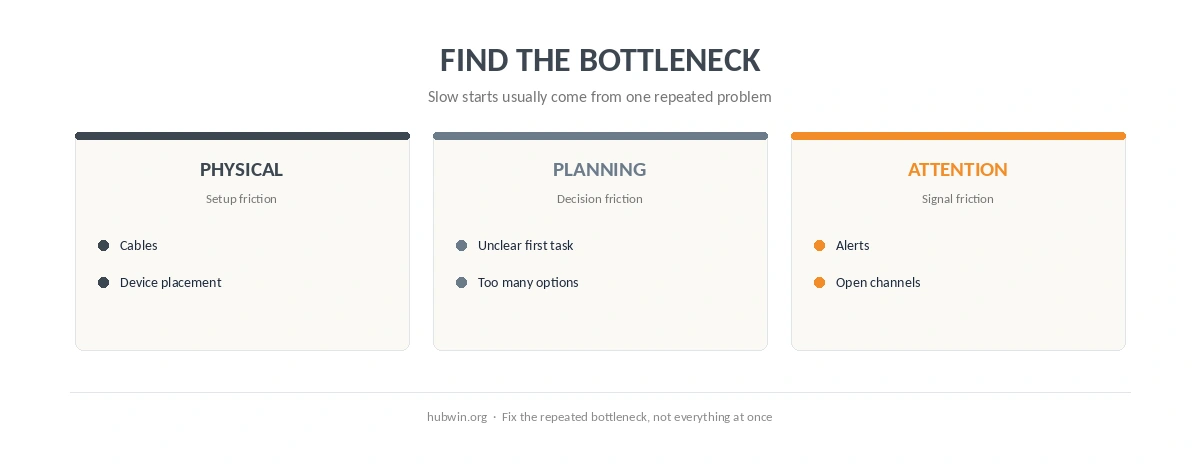
If the startup still feels slow, identify the recurring bottleneck rather than adding a bigger ritual. When the surface is the problem, the functional desk guide can help. For a first-task decision problem, use the time-blocking guide. Alerts and open channels are better handled with the focus guide.
How We Research
HubWin read NIOSH Working from Home guidance and HSE home-working guidance, rechecked October 8, 2026. We also read Gollwitzer and Sheeran’s 2006 meta-analysis of implementation intentions, which included 94 independent tests. We use that evidence only for pre-deciding cue-to-action plans, not to claim that a particular desk ritual is scientifically optimal. Learn how HubWin researches articles.
FAQ
Keep the physical setup in a known state, give routine tools fixed homes, and decide the first work action before the morning begins.
No. A startup routine should remove friction. Larger cleanup belongs in a separate reset if it delays actual work.
No. A short checklist is easier to repeat. Keep only the steps that prevent a recurring delay.
Implementation-intention research supports linking a specific cue to a specific action. That reduces the need to make the same starting decision again.
Use a small portable kit and a fixed setup order. A consistent sequence can still reduce repeated decisions even when the room changes.
The Bottom Line
The practical answer to how to make your desk setup faster to start each day is to standardize the repeatable parts. Reset the workspace, keep routine tools ready, leave a clear first action, and begin. The daily schedule guide can handle the rest of the day after the startup is out of the way.