
Learning how to plan your week as a remote worker works best when the plan is small enough to guide real decisions. A 2023 field experiment with 208 workers and 947 weekly entries tested a brief weekly planning exercise. Participants set priorities, broke work into steps, planned for obstacles and pictured execution. The intervention reduced unfinished tasks and weekly rumination and increased cognitive flexibility, while work engagement did not significantly improve. A related productivity guide covers remote work routine.
How to Plan Your Week as a Remote Worker Without Filling Every Hour
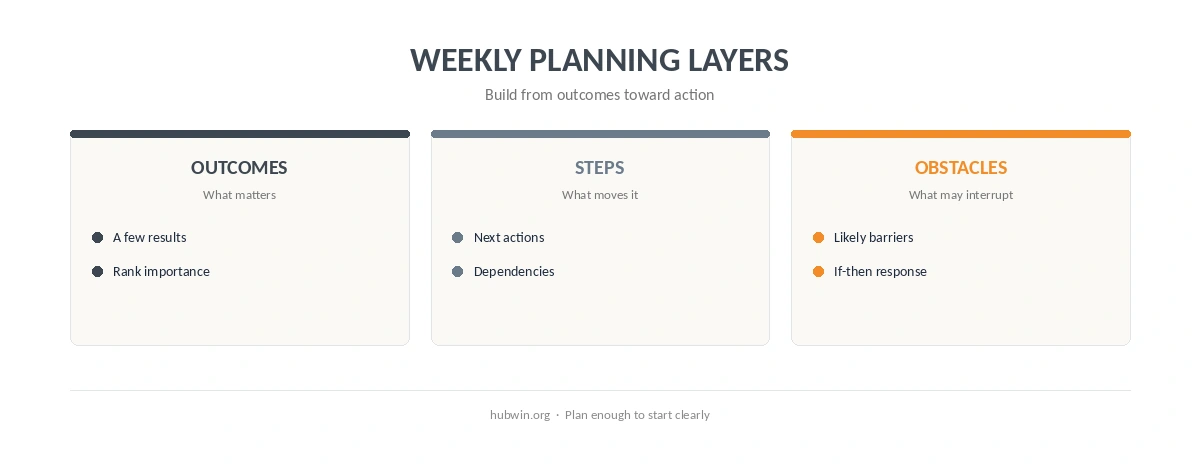
Start with a short list of outcomes rather than a calendar packed with tasks. In the 2023 experiment, participants named three work goals and ranked them by importance. Then they made the top goal specific and realistic. You can use the same principle without copying the study form. The morning checklist can handle daily startup, while the weekly plan decides what deserves attention across several days.
Next, turn the main outcomes into visible steps. This is where how to plan your week as a remote worker becomes practical instead of aspirational. The experiment asked workers to define work steps, deadlines, locations and collaborators. A separate 2006 meta-analysis of 94 independent tests found that implementation intentions, or if-then plans tied to a cue, improved goal attainment across many behaviors. That evidence supports planning for likely obstacles, not predicting the week perfectly.
How to Plan Your Week as a Remote Worker Around Fixed Commitments
Put fixed commitments on the calendar before assigning focus blocks. Calls, deadlines and household constraints create the frame. Then protect a small set of blocks for work that needs sustained attention. The deep-work protection guide and focus-to-calls guide help when meetings split the day. This is another practical way to plan your week as a remote worker without assigning a task to every open hour.
However, leave capacity for work you cannot predict. A weekly plan that assumes every block will run exactly as expected becomes fragile. The interruption guide explains how to leave a restart cue when something urgent breaks a focus block. The context-switching guide covers the opposite problem: too many avoidable transitions.
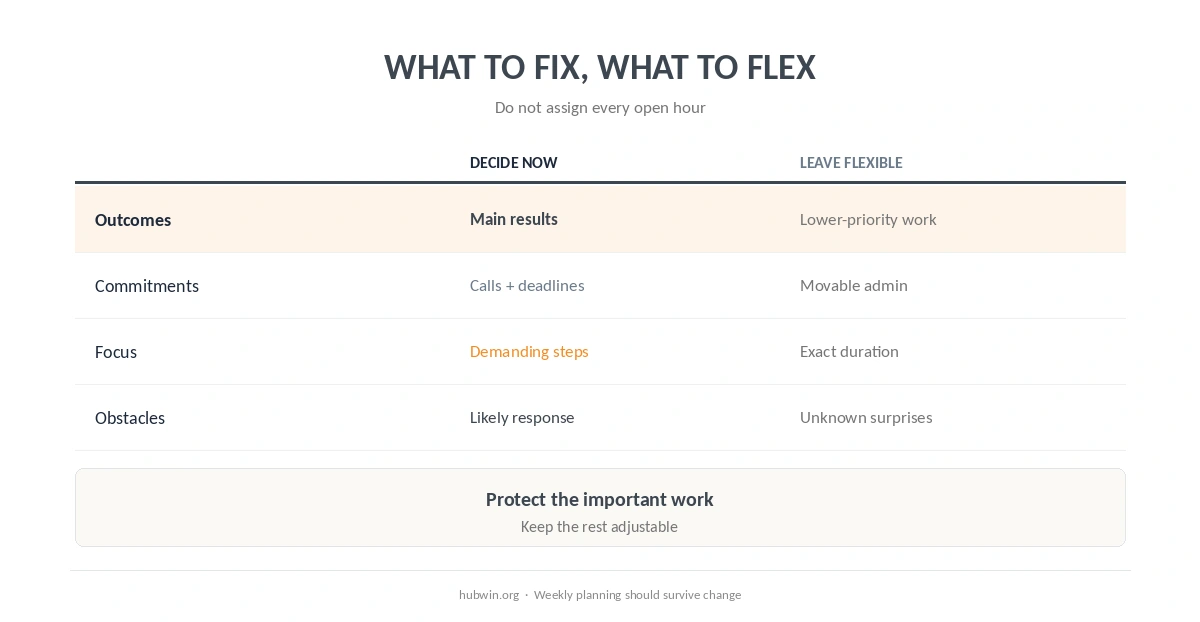
| Plan layer | Decide now | Leave flexible |
|---|---|---|
| Outcomes | A few results that matter this week | Lower-priority tasks |
| Commitments | Calls, deadlines and fixed household needs | Optional meetings or movable admin |
| Focus work | Blocks for the most demanding steps | Exact duration when the workload is uncertain |
| Obstacles | A response to likely interruptions or dependencies | Problems you cannot predict yet |
Use the Weekly Plan to Reduce Open Loops
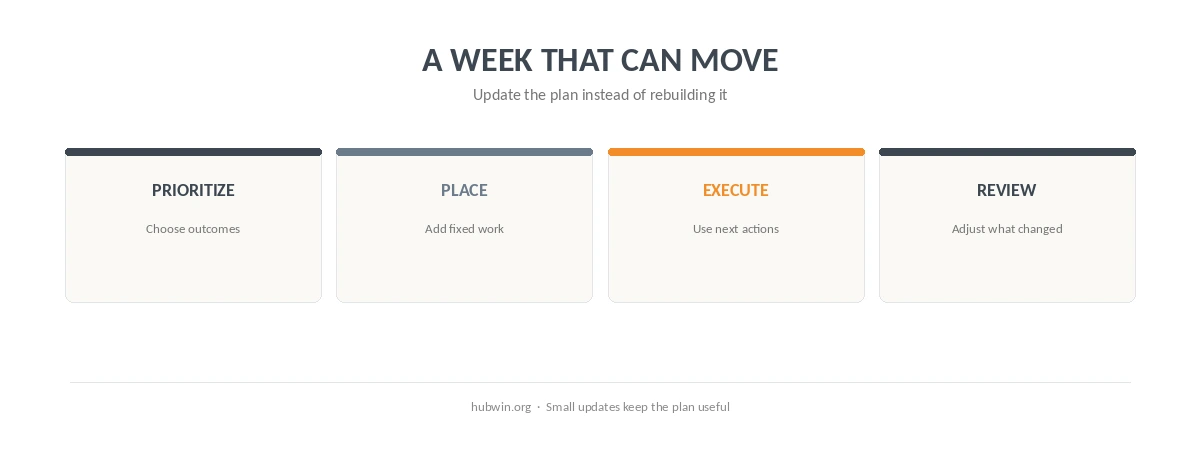
Before the week starts, write down the next visible action for each important outcome. That reduces the need to reconstruct the task every morning. The faster desk startup guide applies the same idea at the desk. The time-blocking guide can then give selected steps a place on the calendar without pretending that every task needs a block. If attention is the bigger constraint, the focus guide helps protect the blocks you already planned.
At the end of each day, update only what changed. The end-of-day guide and shutdown checklist both focus on leaving tomorrow a clear restart cue. Therefore, the weekly plan stays a living reference instead of becoming a document you rewrite from scratch. The morning routine guide can keep the next day consistent without adding another planning system.
How We Research
HubWin read Uhlig and colleagues’ 2023 field experiment on weekly planning behavior, which included 208 workers and 947 weekly entries. We also reviewed Gollwitzer and Sheeran’s 2006 meta-analysis of 94 implementation-intention tests and NIOSH’s working-from-home guidance. Sources were rechecked on October 8, 2026. Learn how HubWin researches articles.
FAQ
There is no universal count. The 2023 field experiment used three work goals, but that was part of the study procedure rather than a rule for every job.
No. Fixed commitments and demanding steps may deserve calendar space, while smaller or uncertain work can stay flexible. For the workflow side of this, see stay accountable working alone.
The 2023 experiment found fewer unfinished tasks, less rumination and higher cognitive flexibility, but it did not find a significant improvement in work engagement.
Update the next actions and priorities that changed. Do not rebuild the entire plan unless the underlying commitments changed substantially.
It can make priorities and restart points clearer. It cannot remove household emergencies, changing workloads or dependencies on other people.
The Bottom Line
The useful answer to how to plan your week as a remote worker is to decide a few outcomes, map their next steps, place fixed commitments first and leave room for change. Research supports structured planning and if-then responses, but it does not support a perfectly packed calendar. The daily schedule guide is the next step if you want to translate the week into one workday. If that is the part of the workflow you want to simplify, see minimum viable workday.