This article is general information, not medical advice. If pain is severe, lasting or getting worse, talk to a doctor. Read our health disclaimer.
To improve circulation while sitting, the safest general advice is to avoid staying motionless for long blocks. Leg-muscle contractions help move blood through the veins. Prolonged immobility can contribute to venous stasis and blood-clot risk. That does not mean ordinary desk sitting causes a clot in a healthy person, or that ankle movements reliably prevent one.
For a normal workday, think in terms of movement opportunities. Use microbreaks, breaks from prolonged sitting and task changes to keep the day from becoming one continuous seated block. People with personal clotting risk need individualized medical advice rather than a generic desk routine.
Improve Circulation While Sitting by Interrupting Immobility
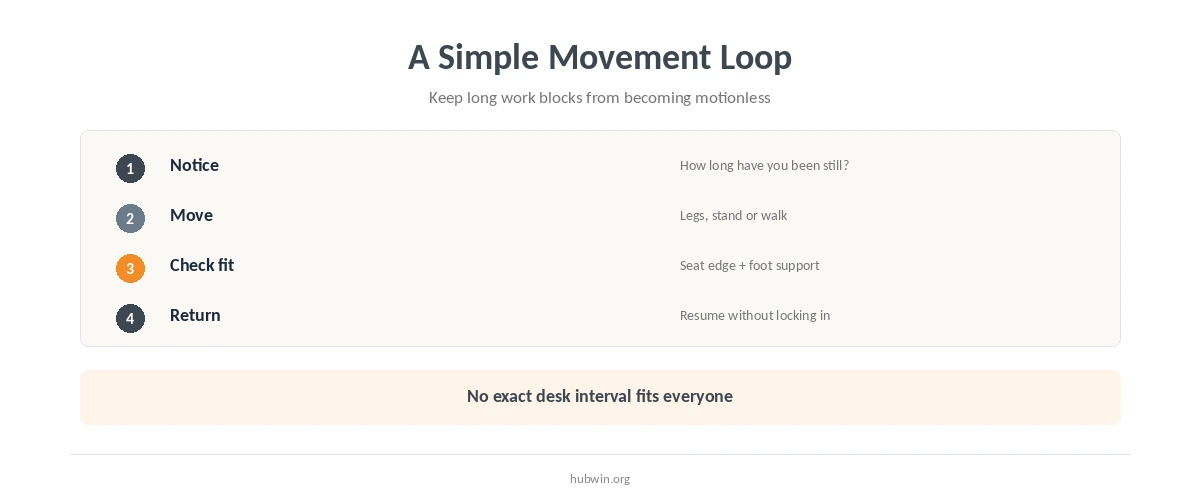
A practical way to improve circulation while sitting is to interrupt immobility. When the legs move, calf muscles contract and help venous blood return. CDC travel guidance recommends moving the legs frequently and taking breaks to walk during long periods of sitting. Travel is not identical to desk work, but the immobility principle is relevant when a work session keeps you still for hours.
Build movement into the workflow instead of waiting for discomfort. You might stand for a phone call, walk to refill water, or use brief between-call movement. A sit-stand routine can add position changes, but standing motionless all day is not the goal either.
Improve Circulation While Sitting Without Turning It into a Medical Protocol
Another way to improve circulation while sitting is to add simple leg movement rather than remain completely still. CDC suggests movements during long travel such as flexing the ankles and working the calf muscles. HubWin does not prescribe a fixed repetition count, hold time or frequency for office work. The project does not invent exercise doses that a source did not establish for desk use.
If you want a broader movement sequence, use the HubWin desk mobility routine or source-backed desk stretches for mobility goals. Those routines support movement and comfort. They do not treat disease or reliably prevent blood clots.
| Situation | General workday response | Important limit |
|---|---|---|
| Long seated focus block | Stand, walk or move the legs periodically | No exact desk interval is proven for everyone |
| Chair edge presses behind knees | Adjust height/depth and support the feet | Comfort change is not a vascular diagnosis |
| Known clotting risk | Ask a clinician about personal prevention | Do not self-prescribe compression or medication |
| One-sided swelling with concerning symptoms | Seek medical assessment promptly | Do not keep testing desk exercises |

Check Whether the Chair Is Adding Pressure Behind Your Legs
OSHA notes that contact stress at the front edge of a chair can contribute to leg discomfort or numbness when the seat edge compresses blood vessels or nerves. Seat height and depth should let your feet rest on stable support. The seat edge should not press hard behind the knees. This is an ergonomic exposure issue, not proof of a circulation disorder.
Review chair adjustment, desk height and supported sitting together. If the desk is too high, lowering the chair without foot support can create a different problem. The aim is a stable position that is easy to leave and change.
Do Not Confuse “Better Circulation” with Sitting Perfectly
A rigid posture is not a circulation strategy. Even a well-fitted workstation benefits from variation. OSHA recommends adjustable workstations and recovery pauses because static loading and repetitive work can fatigue tissues. Movement across the day is more useful than trying to hold one ideal position indefinitely.
Use the daily posture checklist as a reminder to change position. Use the long-hours guide to remove barriers to movement. If new discomfort appears, the body check-in can help you notice a specific chair pressure point or long static block.
Blood Clot Risk Is More Than How Long You Sit at a Desk
DVT risk depends on multiple factors. CDC and Mayo Clinic list prolonged immobility alongside previous clots, clotting disorders, recent surgery or hospitalization, pregnancy, some hormone use, cancer and other medical circumstances. Desk sitting alone does not determine a person’s VTE risk.
If your goal is to improve circulation while sitting because of ordinary stiffness, stay within low-risk ergonomics and movement habits such as simple workstation changes and a general home-office health review. If you know you have VTE risk factors, ask a clinician what prevention is appropriate for you.
When to See a Doctor
Get prompt medical help for possible DVT symptoms such as unexplained swelling, pain or tenderness, warmth, or color change in one leg, especially if you have additional risk factors. A clot can occur without obvious symptoms, so a desk-based self-test cannot rule it out.
Seek emergency care for chest pain, difficulty breathing, coughing up blood, fainting or other signs that could fit a pulmonary embolism. Do not massage a swollen painful leg or keep experimenting with movement if a clot is a concern. Medical assessment comes before workstation troubleshooting.

How We Research How to Improve Circulation While Sitting
HubWin uses CDC and Mayo Clinic sources for VTE risk and warning signs, and OSHA for chair pressure and workstation variation. We distinguish general movement from medical clot prevention and do not recommend compression garments, aspirin or anticoagulants without individualized clinical guidance.
Sources reviewed October 9, 2026: CDC guidance on immobility and blood clots, CDC Yellow Book DVT/PE review, Mayo Clinic DVT guidance, OSHA contact-stress guidance, and OSHA work-process guidance. Read how HubWin researches articles.
Long immobility reduces leg-muscle activity and can contribute to venous stasis, but circulation problems and blood clots have many causes and risk factors.
Change position, move your legs, and take opportunities to stand or walk. The goal is to interrupt immobility rather than perform a precise medical exercise dose.
They can move the calf muscles, but HubWin does not claim they guarantee DVT prevention. People with clotting risk factors should get individualized medical advice.
Yes. Excess pressure behind the knees can contribute to contact stress and discomfort. Adjust seat height and depth and support your feet.
One-sided swelling, pain, warmth or color change needs prompt assessment. Chest pain, breathing difficulty, coughing blood or fainting can be emergency signs of pulmonary embolism.