
This article is general information, not medical advice. If pain is severe, lasting or getting worse, talk to a doctor. Read our health disclaimer.
The ideal desk height for sitting is the height that lets your keyboard and mouse meet your relaxed elbows without forcing your shoulders up or your wrists to bend. That is why official guidance focuses on the relationship between your body, chair and work surface instead of one universal desk number. For the broader setup, see our office ergonomics guidelines.
Ideal Desk Height for Sitting: The Short Answer
The ideal desk height for sitting should place the keyboard around elbow height while your shoulders stay relaxed and your feet stay supported. HSE’s 2025 DSE guidance says the keyboard should sit just below elbow height. CCOHS’s keyboard fact sheet, revised in 2022, adds that the elbows should stay close to the body at about 90 to 110 degrees. A related ergonomics guide covers reach zone.
However, the tabletop itself may sit slightly above the key surface on some setups. OSHA’s purchasing guide, checked October 7, 2026, therefore describes an adjustable keyboard height of 22–30 inches (56–76 cm) for seated tasks. It calls for the keyboard to be about elbow height. That range is equipment guidance, not a claim that every person should pick the same number. For that workstation detail, see office chair armrests.
Ideal Desk Height for Sitting by Your Height
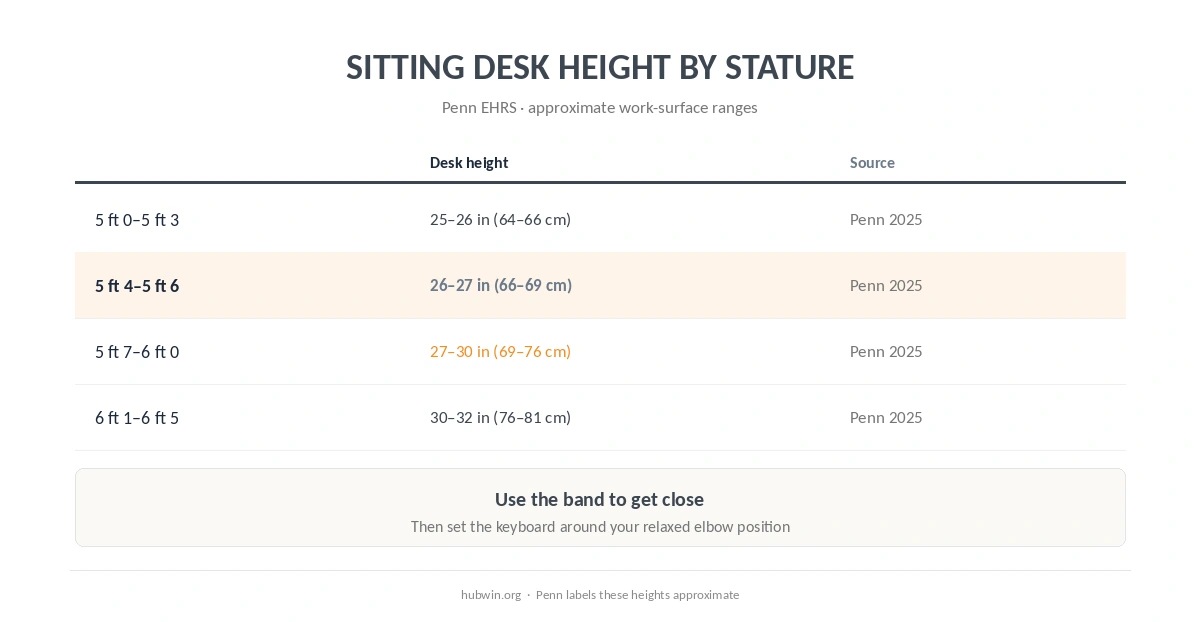
Penn EHRS gives a useful starting chart in guidance last revised July 29, 2025. It explicitly labels the heights as approximate. Therefore, use the chart to get close, then finish the setup by checking your elbows, shoulders, wrists and feet. If that setup matches your space, see corner desk.
| Worker height | Approximate table height | Source |
|---|---|---|
| 5 ft 0 in–5 ft 3 in (152–160 cm) | 25–26 inches (64–66 cm) | Penn EHRS, 2025 |
| 5 ft 4 in–5 ft 6 in (163–168 cm) | 26–27 inches (66–69 cm) | Penn EHRS, 2025 |
| 5 ft 7 in–6 ft 0 in (170–183 cm) | 27–30 inches (69–76 cm) | Penn EHRS, 2025 |
| 6 ft 1 in–6 ft 5 in (185–196 cm) | 30–32 inches (76–81 cm) | Penn EHRS, 2025 |
Penn also notes that a typical office desk is 29–30 inches (74–76 cm) high and may place the keyboard and mouse too high for many workers. In practice, that explains why a fixed “standard desk” can feel wrong even when its dimensions are common.
Measure Your Elbow Before You Trust the Number
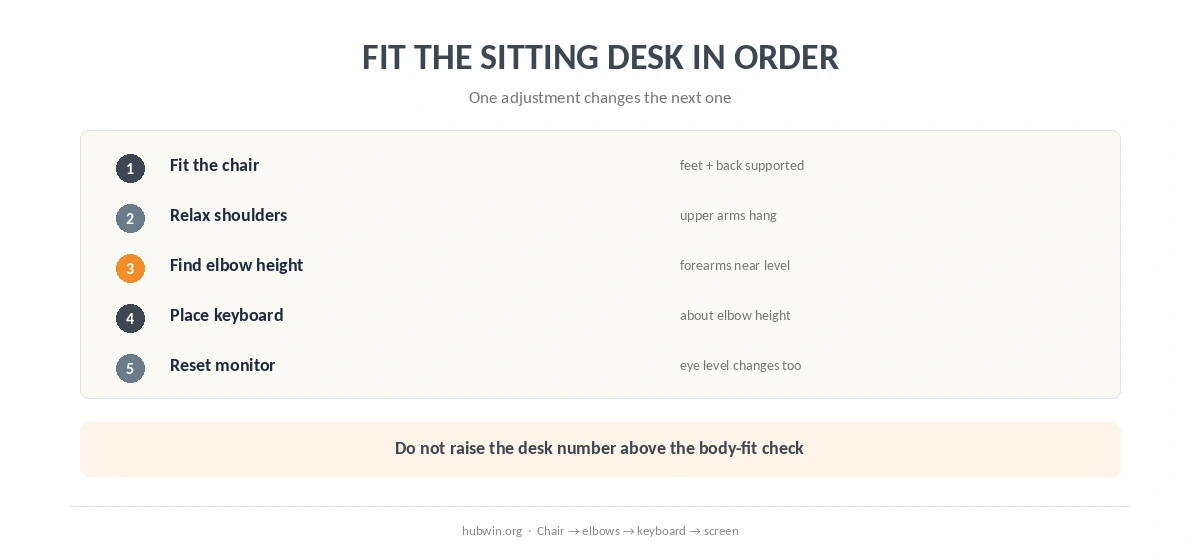
First, set the chair for your body rather than for the desk. CCOHS’s chair-adjustment guidance, confirmed current in 2025, says to support the feet and fit the chair before judging a fixed workstation. Then let the upper arms hang naturally and bend the elbows to about a right angle.
Next, look at where your hands naturally meet the keyboard. If you must shrug to reach the work surface, the setup is too high for that chair position. If you must drop the arms far below the elbows or bend the wrists upward, the relationship is too low or otherwise poorly aligned. In practice, the ideal desk height for sitting is the setting that lets those checks happen together. A related ergonomics guide covers ergonomic setup for short users.
How to Set the Ideal Desk Height for Sitting
- Fit the chair first. Support the feet on the floor or on a footrest, and keep useful back support.
- Relax the shoulders. Let the upper arms hang instead of lifting the shoulders toward the ears.
- Find elbow height. Bring the forearms roughly level and keep the wrists straight rather than bent up or down.
- Bring the keyboard to that zone. HSE places it just below elbow height; OSHA says about elbow height.
- Recheck the screen. Changing chair or desk height can also change monitor height, so reset the display after the input devices.
This sequence also matches the logic in our correct sitting posture guide. The chair and feet create the base. Then the keyboard and mouse come to the hands. Finally, the monitor comes to the eyes.
What If Your Fixed Desk Is Too High?
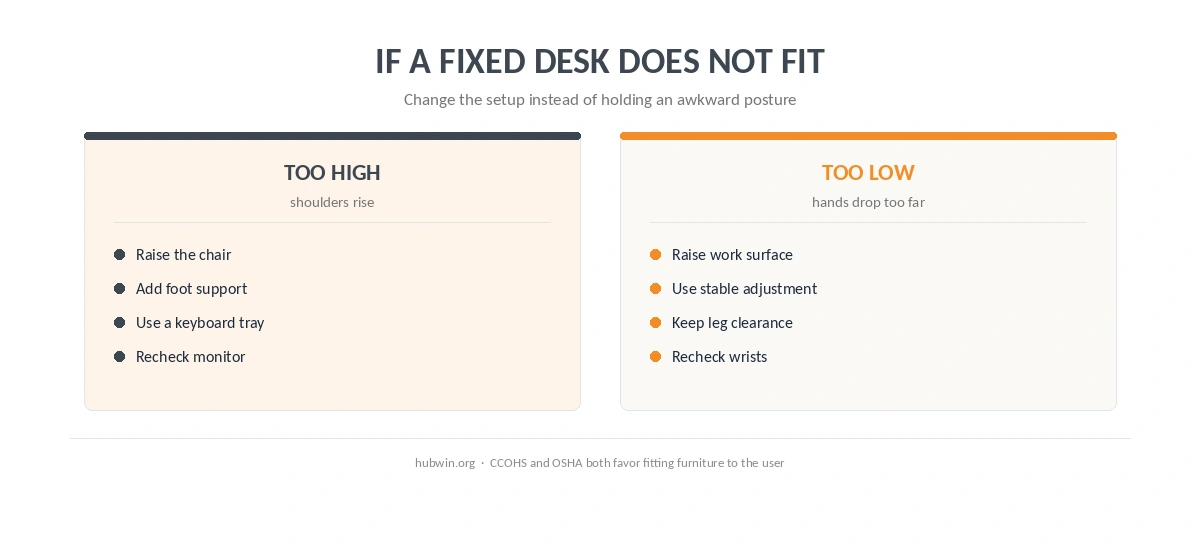
CCOHS gives a direct fix for this situation. After you fit the chair to your height, raise the chair until the elbows are about the same height as the work surface. However, if your feet no longer reach the floor securely, add a footrest instead of leaving them unsupported.
A keyboard tray can solve the same mismatch without raising the whole sitting position. Penn EHRS recommends a tray when height-adjustable furniture is not feasible. OSHA likewise says a fixed-height desk may require a keyboard tray so the input surface can fit a wider range of users.
What If Your Fixed Desk Is Too Low?
OSHA’s desk guidance says a work surface that is too low can create awkward arm and wrist positions. Therefore, a stable riser or a genuinely adjustable desk may be more useful than changing your posture to fit the furniture. OSHA also stresses enough clearance underneath so your legs can move.
Do not solve a low desk by permanently hunching, dropping the head, or pushing the keyboard far away. Instead, change the furniture relationship. A correct number on a tape measure is not useful if the final position still makes you reach or bend.
Why One Universal Sitting Desk Height Does Not Work
Two people of the same height can have different leg, torso and upper-arm proportions. Chair thickness, shoe height, keyboard thickness and the location of the mouse also change the final geometry. Therefore, a height chart can narrow the search but cannot replace a body check.
In addition, the “desk height” can mean different things. Some sources describe the work surface, while OSHA’s purchasing guide specifically gives keyboard-height adjustment. Always check what a number measures before copying it into your setup. For that workstation detail, see ergonomic setup for tall users.
Related: If that is the part of the setup you are working on next, continue with our desk-height chart.
How We Research
HubWin uses a research model and does not test furniture. For this page, the HubWin Team read Penn EHRS office-furniture guidance, last revised July 29, 2025; OSHA’s purchasing guide and desk guidance, checked October 7, 2026; HSE’s DSE posture guidance dated March 20, 2025; and CCOHS keyboard and chair-adjustment pages with their stated revision or confirmation dates. See About HubWin for our method.
FAQ
It is the height that lets the keyboard meet relaxed elbows while the wrists stay straight and the feet remain supported. Official sources do not give one universal number for every body.
It can be. Penn EHRS says typical 29–30-inch (74–76-cm) desks can place the keyboard and mouse too high for many workers, while its approximate table-height chart reaches 30 inches (76 cm) only in taller height bands.
Treat elbow height as a fitting target for the keyboard area. HSE says just below elbow height, while OSHA says about elbow height.
CCOHS recommends raising the chair until elbows are about work-surface height, then using a footrest if the feet lose floor support. A keyboard tray is another option.
Use a height chart only as a starting point. Body proportions and chair setup change the final elbow position.
Bottom Line
The ideal desk height for sitting is a relationship, not a furniture standard. Start with the approximate Penn ranges if you need a number, then fit the chair and check elbow height. Keep the shoulders relaxed, wrists straight and feet supported. If a fixed desk prevents those conditions from happening together, change the chair, add a footrest or keyboard tray, or change the work surface. For that related comfort question, see circulation while sitting.