
Remote work makes the end of the day easy to blur. How to create a shutdown ritual after work is not about performing a perfect routine. It is about giving unfinished work a clear place to go, closing active channels, and creating a repeatable cue that work time has ended.
Research supports the broader goal more strongly than any exact ritual. A 2023 systematic review synthesized 159 studies on psychological detachment from work. A separate meta-analysis of 30 studies and 34 interventions found a small positive average effect on detachment. Neither review says everyone needs the same five-step evening routine.
Therefore, use a ritual as a boundary tool rather than a productivity superstition. The end-the-workday guide covers the broader transition, while this page focuses on a short repeatable sequence you can run before you leave the desk.
How to Create a Shutdown Ritual After Work: Close the Open Loops
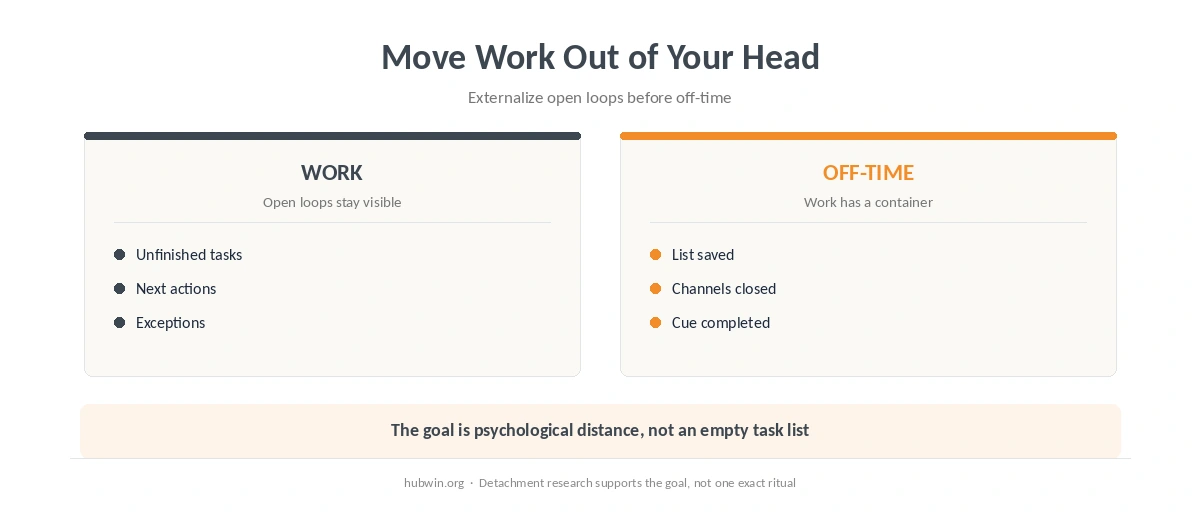
First, capture unfinished work. Write down what still needs attention and the next visible action. That reduces the need to keep rehearsing the task mentally just to remember it. Keep the list short enough that tomorrow can start from it. In practice, how to create a shutdown ritual after work starts by giving unfinished tasks a trusted place outside your head.
Next, review the next workday only far enough to remove ambiguity. The weekly planning guide can hold larger commitments, while the morning checklist gives tomorrow a clean starting point. Do not turn shutdown into another planning session. The daily schedule guide can hold routine time blocks so shutdown does not have to rebuild the day from scratch. A related productivity guide covers a weekly review for remote work.
Then close the channels that keep work active: work tabs, chat windows, documents and unnecessary notifications. If something truly needs an evening response, define that exception before ending the day instead of leaving every channel half-open.
- Capture unfinished work and one next action.
- Check tomorrow’s first commitment or task.
- Close work documents, tabs and communication tools that do not need to remain active.
- Reset the desk only enough to remove friction for the next start.
- Use one consistent end cue: leave the room, change lighting, take a walk or switch to a non-work activity.

How to Create a Shutdown Ritual After Work: Keep It Short Enough to Repeat
A ritual becomes counterproductive when it expands into an extra hour of work. Instead, set a small scope: capture, close, reset and leave. The quick-reset desk routine can handle the physical workspace in a few steps. The end-of-day checklist offers a broader operational review when you need one.
Also separate shutdown from “finishing everything.” Remote work rarely offers a natural empty inbox. The overworking guide explains why a stopping rule matters when tasks have no obvious endpoint. Likewise, the work-life boundary guide covers spatial and digital cues that make the transition easier.
| Shutdown step | Question | Stop when |
|---|---|---|
| Capture | What remains unfinished? | The next action is recorded |
| Tomorrow | What needs to start first? | The first priority is visible |
| Close | What can stop demanding attention? | Nonessential work channels are closed |
| Reset | What will slow tomorrow’s start? | The desk is usable |
| Leave | What marks non-work time? | You perform the chosen end cue |

Use Boundaries That Match Your Home
If other people share the space, make the end cue visible. The family-boundary guide and roommate guide show ways to communicate availability without constant negotiation.
If your problem is mental carryover rather than household interruption, protect the final work block from unnecessary switching. The deep-work protection guide and time-blocking guide can reduce the open threads you bring into shutdown.
However, avoid treating detachment as a pass/fail test. The 2023 review describes detachment as an important recovery experience, but people face different job demands and boundary conditions. A ritual is useful when it makes stopping easier, not when it creates a new reason to judge the evening. This is also how to create a shutdown ritual after work without turning it into another performance target.
How We Research
HubWin read Agolli and Holtz’s 2023 systematic review of 159 empirical studies on psychological detachment and Wendsche et al.’s meta-analysis of detachment interventions, which included 30 studies and 34 interventions. These sources support detachment as a recovery target; they do not validate one universal shutdown ritual. Learn how HubWin researches articles.
FAQ
The research above does not prescribe a universal duration. Keep the ritual short enough to repeat and long enough to capture unfinished work and close your active work channels.
No. The purpose is to create a stopping point, not to eliminate every open task.
Research supports psychological detachment and interventions that can improve it. The exact ritual in this article is a practical implementation, not a uniquely validated protocol.
Define the later block as an explicit exception with a start and stop point instead of keeping the whole evening mentally on call.
Capture specific unfinished tasks and next actions, then use a clear transition into non-work time. Persistent difficulty detaching may also reflect workload or boundary problems that a ritual alone cannot solve.
The Bottom Line
The useful answer to how to create a shutdown ritual after work is to make the ending concrete: capture unfinished work, identify tomorrow’s first step, close active channels, reset the desk and perform one end cue. Keep it repeatable. The goal is a clearer boundary, not a flawless evening routine.