To stop overworking when working from home, treat the end of work as a boundary you design rather than a feeling that appears automatically. NIOSH advises remote workers to keep a routine, set time and space boundaries, take breaks and detach at the end of the day. A 2023 systematic review of 159 empirical studies also identified psychological detachment as an important recovery experience.
Stop Overworking When Working from Home by Defining the End Before the Day Starts
Decide what will count as finished enough before late-day fatigue makes the decision for you. That can mean a scheduled stop time, a final task boundary or a handoff note for tomorrow. The end-workday guide and end-of-day checklist both focus on closing loops instead of continuing until the inbox is empty.
Next, make tomorrow visible. The desire to keep working often grows when unfinished work feels undefined. The weekly planning article is not published yet, so use the existing WFH productivity checklist and desk-startup guide to leave one clear restart action. This makes it easier to stop overworking when working from home without pretending every task is complete.

Stop Overworking When Working from Home by Separating Availability from Work
Being reachable does not require active work all evening. Turn off nonessential work alerts after the boundary you have chosen. The distraction-management guide and deep-work guide both distinguish intentional communication from constant signal-driven checking. This separation is one concrete way to stop overworking when working from home when the problem is unnecessary availability rather than required on-call work.
Physical cues can help when home and work share the same room. Put away the laptop, move call gear, or reset the desk for the next day. The quick-reset article is not published yet, so use the current work-life boundaries guide and flexible setup guide for this transition.
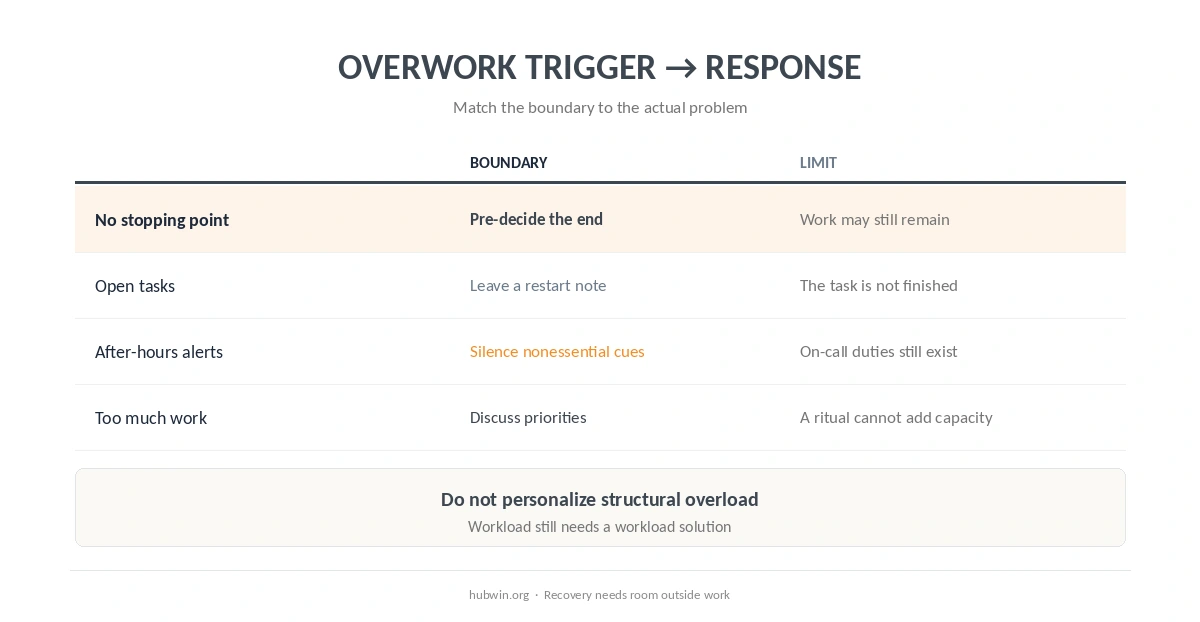
| Overwork trigger | Boundary response | What it does not promise |
|---|---|---|
| Unclear stopping point | Choose a stop rule before late-day work | It does not make all work disappear |
| Open tasks | Leave a next-action note for tomorrow | It does not finish the task |
| Constant alerts | Silence nonessential work channels off-hours | It does not remove true on-call duties |
| Work gear always visible | Reset or store movable work items | It does not create a separate room |
Do Not Turn a Workload Problem Into a Personal Routine Problem
If the workload regularly exceeds the available hours, a better shutdown ritual cannot solve the mismatch. The 2023 detachment review emphasizes that job demands and work conditions influence detachment. A 2023 randomized trial of 575 workers with flexible work designs found that a six-week self-regulation intervention improved detachment, work-life balance satisfaction and well-being relative to the waitlist control. However, the intervention included several strategies, so it does not prove that one boundary trick will solve chronic overwork. The daily schedule guide can expose that mismatch when the planned workload repeatedly spills beyond the available day.
That distinction matters. Discuss priorities, deadlines or staffing when the amount of work itself is unrealistic. Personal boundaries can support recovery, but they should not hide structural overload. The burnout article explains why burnout is an occupational phenomenon rather than a personal failure to optimize a routine.
How We Research
HubWin read NIOSH’s working-from-home guidance, Agolli and Holtz’s 2023 systematic review of 159 studies on detachment from work, and Althammer and colleagues’ 2023 randomized trial of 575 workers with flexible work designs. HubWin rechecked these sources on October 8, 2026. Learn how HubWin researches articles.
FAQ
Remote work can blur time and space boundaries, while unfinished tasks and always-available communication can keep work mentally present after hours.
A fixed time can help some jobs, but deadlines, shifts and on-call duties differ. Use a boundary that matches the real work arrangement.
No. It can reduce avoidable work cues, but it cannot solve unrealistic workloads, staffing problems or required on-call responsibilities.
No. Research uses detachment to describe mentally disengaging from work during off-job time so recovery can occur.
Clarify expectations and priorities rather than relying only on a personal routine. Organizational demands are part of the problem when availability expectations are unrealistic.
The Bottom Line
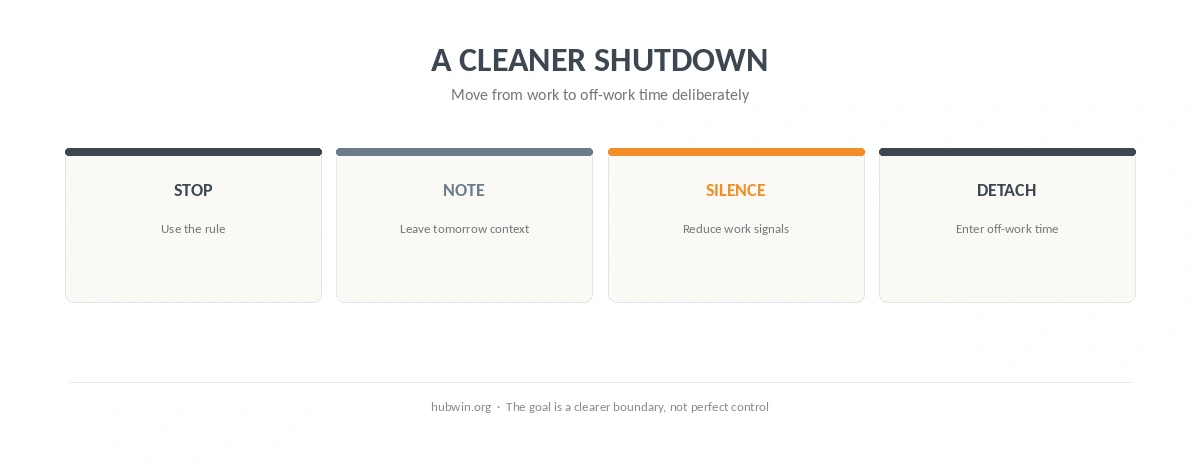
To stop overworking when working from home, define a stopping rule, leave tomorrow a restart cue, reduce unnecessary after-hours signals and create a visible transition out of work. Research supports the importance of detachment and boundary strategies, but routines cannot compensate for a workload that consistently exceeds available time. The work-life boundaries guide can help you formalize the next step.