
This article is general information, not medical advice. If pain is severe, lasting or getting worse, talk to a doctor. Read our health disclaimer.
Can poor desk setup cause long-term damage? A poor workstation can add recognized risk factors for work-related musculoskeletal disorders, but the phrase “long-term damage” is broader than the evidence allows. OSHA links prolonged awkward posture, repetition and static work with fatigue and injury risk. A 2024 systematic review of 25 computer-worker studies also found associations with prolonged computer use and awkward posture. Neither source says one imperfect desk inevitably causes permanent damage.
Can Poor Desk Setup Cause Long-Term Damage? What the Evidence Supports
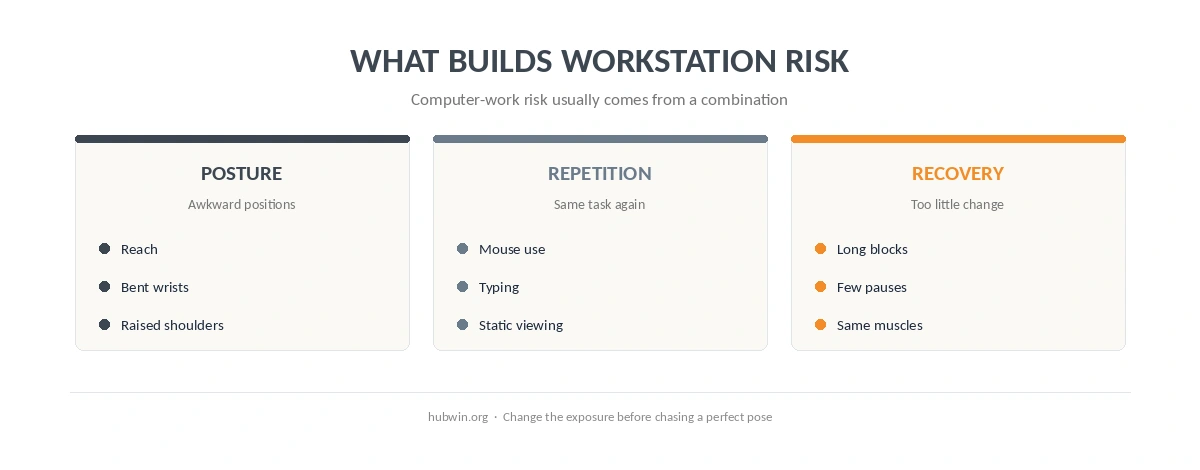
The useful answer starts with exposure, not fear. OSHA’s current computer-workstation guidance says repeated reaching, bent wrists, raised shoulders and prolonged static positions can irritate or strain tissues. It also says risk rises when repetition combines with awkward posture or force. Therefore, the office ergonomics guide focuses on reducing those exposures rather than promising one “correct” pose.
The 2024 systematic review by Demissie and colleagues included 25 studies of computer users. It reported that prolonged computer use and awkward posture appeared among the factors associated with work-related musculoskeletal disorders. However, the review pooled observational evidence with different populations and methods. So can poor desk setup cause long-term damage is not a yes-or-no causal test. The safer conclusion is that a poor setup can contribute to risk alongside workload, repetition, individual factors and time.
Start with patterns you can actually observe. The desk-setup pain guide asks whether symptoms reliably appear during one task. Then check the sitting-position guide and daily posture checklist. Those pages treat posture as a changing working position, not a diagnosis.
Can Poor Desk Setup Cause Long-Term Damage by Itself? Usually That Is the Wrong Question
A workstation is one part of the exposure. For example, a mouse placed far away can create repeated shoulder reach. A high screen can keep the neck tilted. A keyboard can also encourage bent wrists. The keyboard and mouse guide and monitor-height guide show how to remove those obvious mismatches.
However, symptom duration does not tell you the cause. Pain can persist for reasons unrelated to the desk, and a comfortable setup cannot rule out a medical problem. That is why the home-office health checklist separates workstation observations from warning signs. The simple ergonomic changes guide is for reducing avoidable strain, not for treating an injury. Another way to ask whether a poor desk setup can cause long-term damage is to look at exposure over time rather than predict one outcome from one desk.
| Claim | What the evidence supports | Practical takeaway |
|---|---|---|
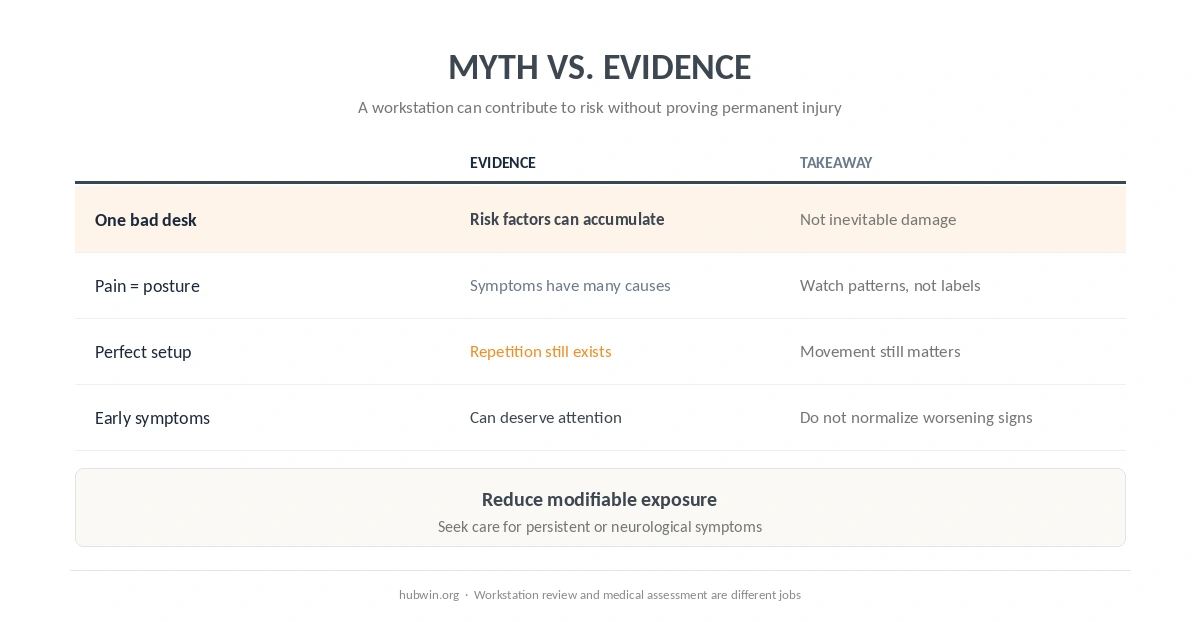
| “One bad desk permanently damages your body” | Too broad; workstation studies show risk associations, not an inevitable outcome | Reduce repeated awkward exposure without assuming a diagnosis |
| “If it hurts, posture must be the cause” | Symptoms can have multiple causes | Notice task patterns and seek care when symptoms persist |
| “A perfect setup removes all risk” | Even a good setup still includes repetition and static work | Change activity and position during the day |
| “Early symptoms do not matter” | OSHA advises recognizing MSD signs before problems progress | Do not ignore persistent numbness, weakness or loss of function |
Reduce Exposure Instead of Chasing a Perfect Desk
First, bring frequently used controls close enough that your shoulders stay relaxed. Second, keep the main screen in front of you. Third, vary the work instead of holding one position for hours. OSHA’s work-process guidance recommends short recovery periods and task variation for highly repetitive or static computer work. The microbreak guide explains that idea without turning it into a rigid timer.
If one body area keeps flaring during computer work, use a focused guide rather than rebuilding everything at once. The wrist-pain guide, upper-back guide and lower-back guide each separate setup changes from medical red flags. This keeps the workstation review narrow and useful.
When to See a Doctor
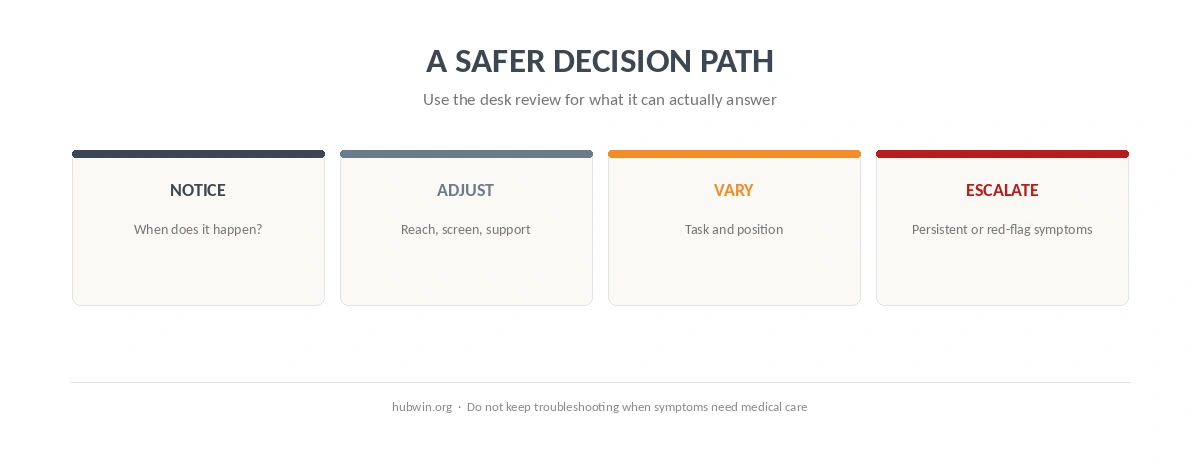
Do not keep troubleshooting the desk when symptoms are severe, worsening or persistent. NHS shoulder guidance, reviewed in 2023 and checked in 2026, advises urgent help for sudden severe shoulder pain, inability to move the arm, major swelling or shape change, persistent pins and needles, loss of feeling, or pain after an injury. Mayo Clinic neck guidance checked in 2026 also flags weakness, numbness or tingling that spreads into a limb. These patterns need medical assessment rather than another workstation adjustment.
How We Research
HubWin read OSHA’s Computer Workstations eTool, its work-process guidance and NIOSH’s ergonomics risk-factor page. We also reviewed the 2024 systematic review of work-related musculoskeletal disorders among computer users. Sources were rechecked on October 8, 2026. Learn how HubWin researches articles.
FAQ
A poor setup can contribute to prolonged awkward or static exposure, but it does not prove the cause of back pain or make permanent injury inevitable.
There is no universal timeline. Exposure depends on task duration, repetition, posture, force, recovery and individual factors.
No single chair removes every workstation risk. Screen position, input-device reach, task organization and movement still matter.
That pattern makes the workstation worth reviewing, but it still does not diagnose the cause. Persistent or neurological symptoms need medical assessment.
Exercise does not make workstation exposure irrelevant. Reduce avoidable work stressors while treating exercise as a separate health behavior.
The Bottom Line
So, can poor desk setup cause long-term damage? It can contribute to recognized musculoskeletal risk factors, especially when awkward positions, repetition and static work continue for long periods. But the evidence does not justify saying one bad desk inevitably causes permanent damage. Reduce the exposures you can see, vary activity, and get persistent or concerning symptoms assessed.