
This article is general information, not medical advice. If pain is severe, lasting or getting worse, talk to a doctor. Read our health disclaimer.
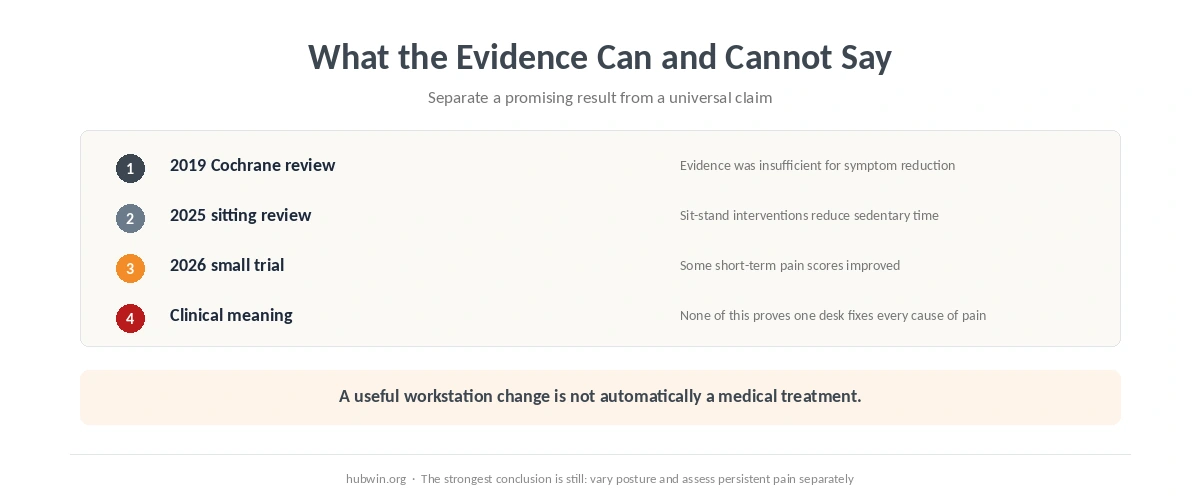
Do standing desks fix back pain? The best answer is no—not in the strong, universal sense that the phrase suggests. A 2019 Cochrane review found insufficient evidence that sit-stand or treadmill workstations reduce the intensity of low-back or upper-back symptoms. Newer research is more encouraging in some groups, but it still does not turn a sit-stand desk into a treatment for every cause of back pain. Read the 2019 Cochrane review.
Do Standing Desks Fix Back Pain? Start With the Evidence Hierarchy
The 2019 Cochrane review included 10 studies with 955 workers. The reviewers rated much of the evidence low or very low quality. They concluded that interventions increasing standing or walking had not conclusively reduced musculoskeletal symptoms. That distinction matters because reducing sitting and reducing pain are different outcomes. The standing-desk myths guide covers the broader evidence behind that difference.
A 2025 systematic review in HubWin’s evidence table found less workplace sedentary time with sit-stand interventions at several follow-ups. That supports sit-stand desks as a way to change sitting exposure. It does not, by itself, show that standing desks fix back pain. For the practical side of posture variation, see the simple ergonomic changes guide.
Why New Research Still Does Not Prove Standing Desks Fix Back Pain for Everyone
A randomized trial published in 2026 studied 56 desk-based workers who already had lower-back pain. Both groups used sit-stand recommendations. One group followed a fixed pattern of 30 minutes sitting and 15 minutes standing; the other used a personalized pattern. After three months, the fixed-ratio group reported a 1.33-point reduction on a 10-point scale for worst pain and a 0.83-point reduction for average pain. The personalized group reported a 0.69-point reduction in worst pain. Read the 2026 randomized trial.
That result is worth noticing, but the trial did not include a usual-sitting group without a sit-stand intervention. It compares two sit-stand strategies rather than proving that a standing desk caused the improvement. The sample was small, and follow-up lasted three months. A careful conclusion is that specific sit-stand strategies may help some workers with lower-back pain in the short term. The study does not show that standing desks fix back pain in general.
Use a Standing Desk for Variation, Not Standing Endurance
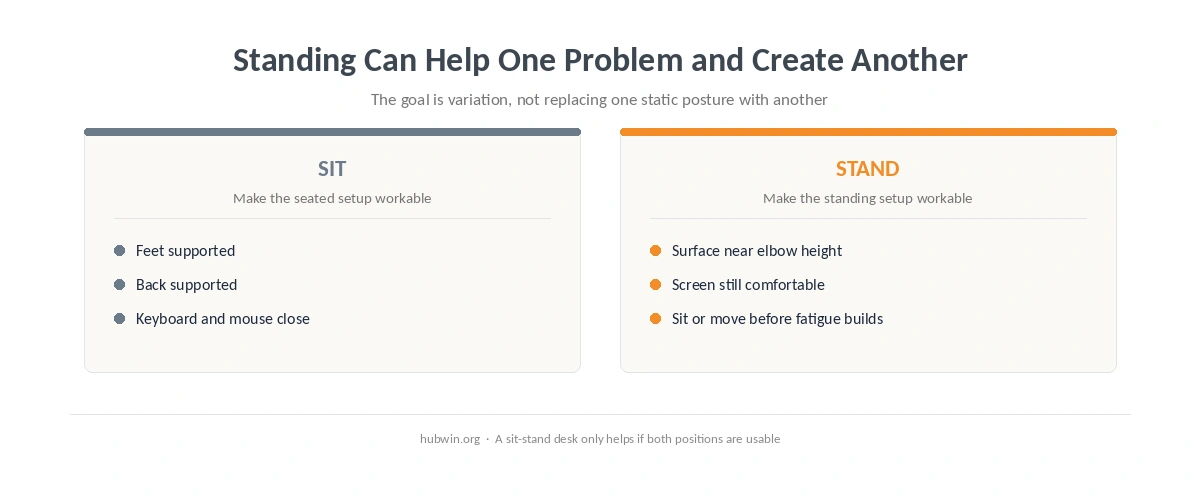
CCOHS sit-stand guidance says recommended sitting and standing intervals vary. It emphasizes alternating positions as needed and allowing time to adapt. That matches the broader lesson from HubWin’s sit-stand transition guide: the useful feature is the ability to change position, not a target number of standing minutes. The office ergonomics guidelines explain the same principle across the rest of the workstation.
All-day standing is not the fallback. NIOSH’s review of prolonged occupational standing reported consistent evidence of low-back discomfort, fatigue, muscle pain and leg symptoms with prolonged standing. Our standing-versus-sitting review explains why replacing one static posture with another misses the point. The microbreak guide adds the missing piece: changes of activity away from the same posture and screen task.
In practice, make both positions usable. Start with the standing desk-height guide. Keep the keyboard and mouse near the elbows, and make sure the screen remains comfortable to view after the desk moves. If the seated setup is poor, the office-chair adjustment guide is just as relevant. The home-office ergonomics checklist helps catch mismatches that appear only after the desk changes height.
When Back Pain Needs Medical Care Instead of More Standing
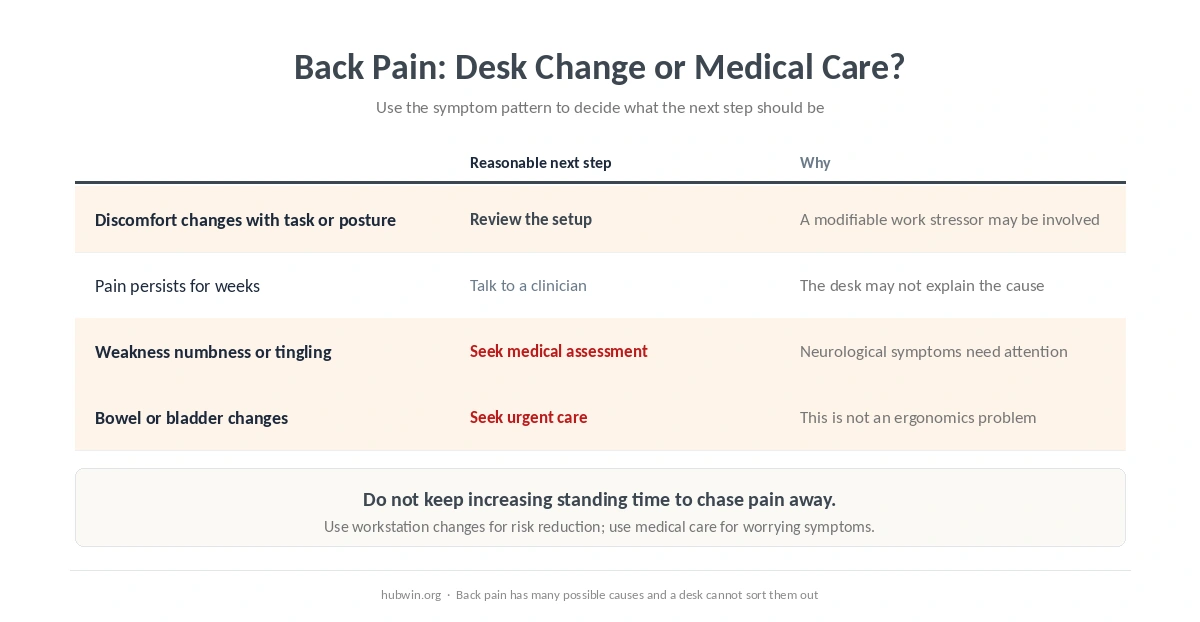
Back pain has many possible causes. Mayo Clinic guidance updated in 2024 advises medical evaluation when pain persists, stays constant or intense, spreads down one or both legs, or comes with weakness, numbness or tingling. Mayo Clinic recommends urgent care for new bowel or bladder problems, fever or pain after significant trauma. See Mayo Clinic’s back-pain guidance.
NHS guidance current in 2026 also treats weakness or numbness in both legs, loss of feeling around the genitals or anus, bladder or bowel changes, chest pain and pain after a serious accident as emergency warning patterns. Those symptoms are not a reason to stand more. They are a reason to get medical help. The broader back-pain guide separates ordinary workstation changes from warning signs, while the sitting and lower-back-pain guide looks at the evidence on sitting behavior. Read the NHS guidance.
How We Research
HubWin reviewed the 2019 Cochrane review of workplace standing and walking interventions, the randomized sit-stand trial published in 2026, CCOHS sit-stand guidance, NIOSH evidence on prolonged standing, Mayo Clinic back-pain guidance updated in 2024, and NHS back-pain guidance current in 2026. Sources were checked on October 8, 2026. Learn how HubWin researches articles.
FAQ
It may help some people, and a small 2026 trial found short-term improvements under specific sit-stand schedules. The broader evidence is not strong enough to call standing desks a universal treatment.
No study can diagnose the cause of your pain from the fact that you sit. A sit-stand desk changes posture exposure; it does not prove why pain exists.
There is no universal evidence-based standing interval for back pain. CCOHS recommends alternating positions and allowing time to adapt rather than forcing one ratio.
No. Prolonged standing is also associated with discomfort and fatigue. Variation and movement are safer general goals than all-day standing.
Seek medical advice for persistent or worsening pain and for pain with weakness, numbness, tingling or other concerning symptoms. Some bowel, bladder, trauma and neurological symptoms need urgent care.
The Bottom Line
The claim that standing desks fix back pain is too strong. Sit-stand desks can reduce sitting and may help some workers, but the evidence is mixed and newer positive trials have important limits. Use the desk to create posture variation. Do not use it as a substitute for medical assessment when pain persists or comes with warning signs.