How to avoid procrastination working from home gets easier when “start working” stops being one vague instruction. A 2024 meta-analysis of 642 implementation-intention tests found benefits from specific if–then plans. NIOSH work-from-home guidance also recommends routines, boundaries and protected focus times. Read the 2024 planning meta-analysis.
How to Avoid Procrastination Working from Home: Define the First Visible Action
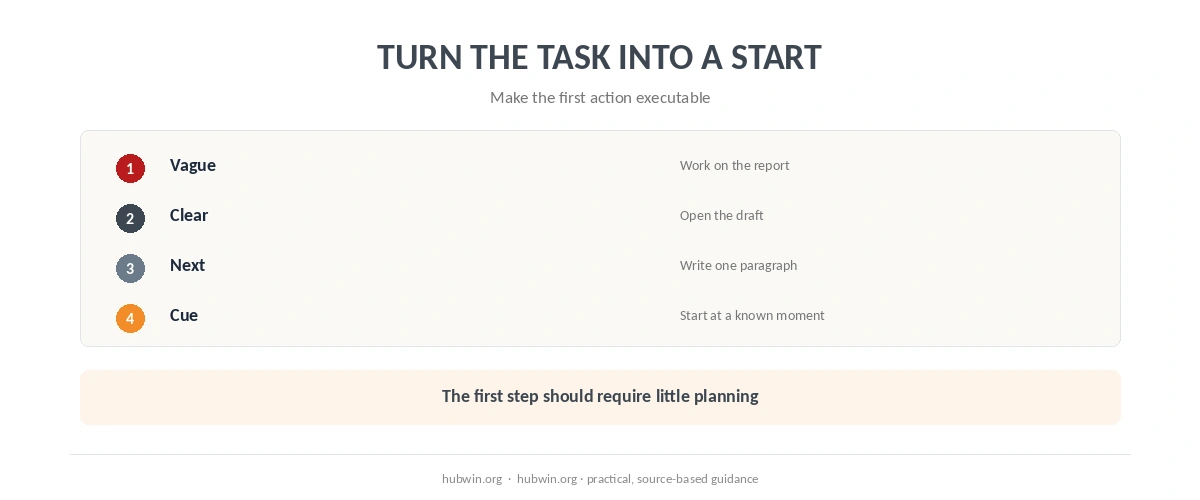
The first step in how to avoid procrastination working from home is to shrink the start. “Work on report” still requires decisions. “Open the draft and write the first paragraph” is executable. Use the morning-routine guide and productivity checklist to decide the first task before the workday begins.
Use a cue that can trigger the start. It might follow breakfast, the first calendar check or the start of a focus window. The point is not the ritual itself. It is reducing the decisions between intending to work and beginning the task.
One way to avoid procrastination working from home is to make the start cue visible before competing tasks appear.
How to Avoid Procrastination Working from Home by Reducing Competing Starts
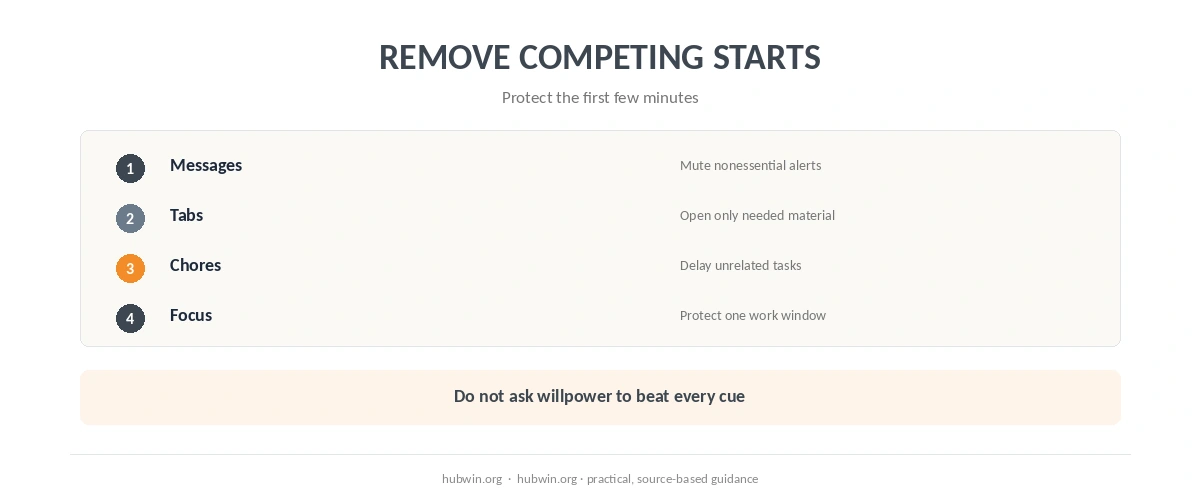
A home environment offers many alternative starts: email, messages, laundry, news, another browser tab. Remove the alternatives that repeatedly win the first five minutes. The distraction-free office guide and distraction-management guide focus on reducing those competing cues rather than relying only on self-control.
For harder work, protect one uninterrupted window instead of demanding perfect focus all day. The deep-work guide, focus guide and noisy-home focus guide all emphasize reducing switching costs around demanding tasks.
Use If–Then Planning for Predictable Procrastination Triggers
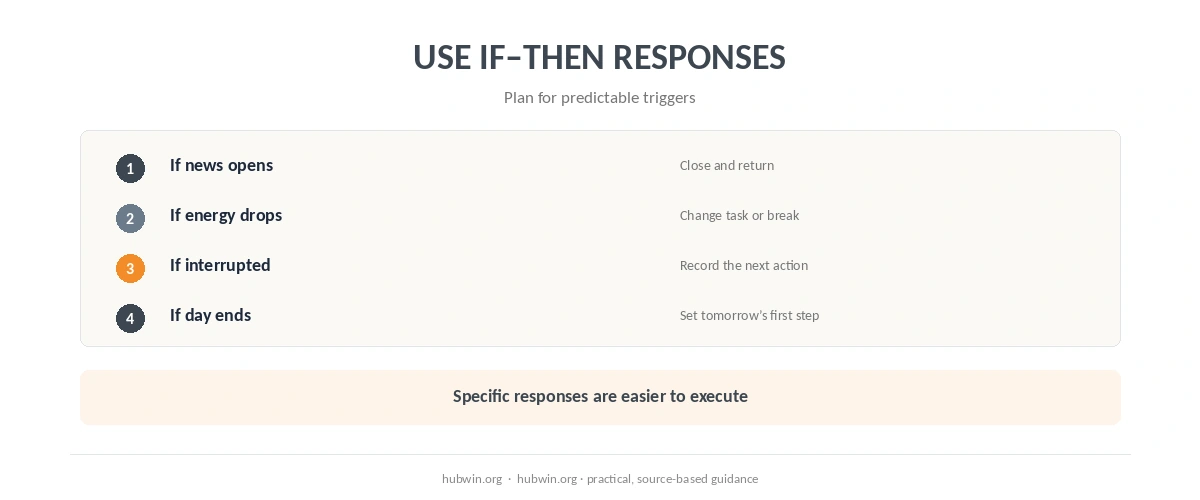
Implementation intentions use a specific form: “if situation X occurs, then I will do Y.” The 2024 review found stronger effects for contingent if–then formats. For work, keep the response simple. For example: “If I open news during the focus block, I will close it and return to the next line in the outline.” This remains a planning tool, not a guarantee.
Keep the response small enough to execute immediately. If tiredness is the trigger, use the afternoon-slump guide or breaks guide. Do not label every low-energy period as procrastination.
Make Tomorrow Easier Before Today Ends
Procrastination often starts before the next day begins: unfinished work has no clear next action, so reopening it feels expensive. The end-of-day routine and shutdown checklist solve that by recording where to restart.
NIOSH also recommends routines, boundaries and detaching at the end of the day. The work-life boundaries guide addresses the opposite problem: work expanding deep into home time. That can make tomorrow’s start feel heavier. Read NIOSH work-from-home guidance.
How We Research
HubWin reviewed the 2024 meta-analysis of 642 implementation-intention tests, NIOSH’s 2020 work-from-home guidance, and Sophie Leroy’s 2009 attention-residue experiments. These sources support specific planning and reduced switching; they do not prove that one productivity system removes procrastination for everyone. Learn how HubWin researches articles.
FAQ
Define one visible action you can do immediately, such as opening the draft and writing the next paragraph.
A 2024 meta-analysis covering 642 tests found positive effects across several outcome types, with stronger effects for contingent if–then formats.
It can help when a specific site repeatedly interrupts the start, but the larger goal is reducing predictable competing cues.
Not necessarily. Low energy and procrastination can look similar. Change the task or take a break when energy is the real issue.
Write the next action for unfinished work so tomorrow begins with a clear start rather than a new planning session.
The Bottom Line
A practical answer to how to avoid procrastination working from home is to make the start concrete. Remove predictable distractions, use specific if–then responses and leave tomorrow a clear next action.