Better focus in a noisy home starts with accepting that some sound is not under your control. NIOSH recommends creating focus times and choosing a work environment where you can control noise as far as possible. When that is only partly possible, the useful question becomes narrower: which tasks truly need protection, and which can survive a noisier window? Read the NIOSH working-from-home guidance.
Focus in a Noisy Home: Protect the Task That Needs It Most
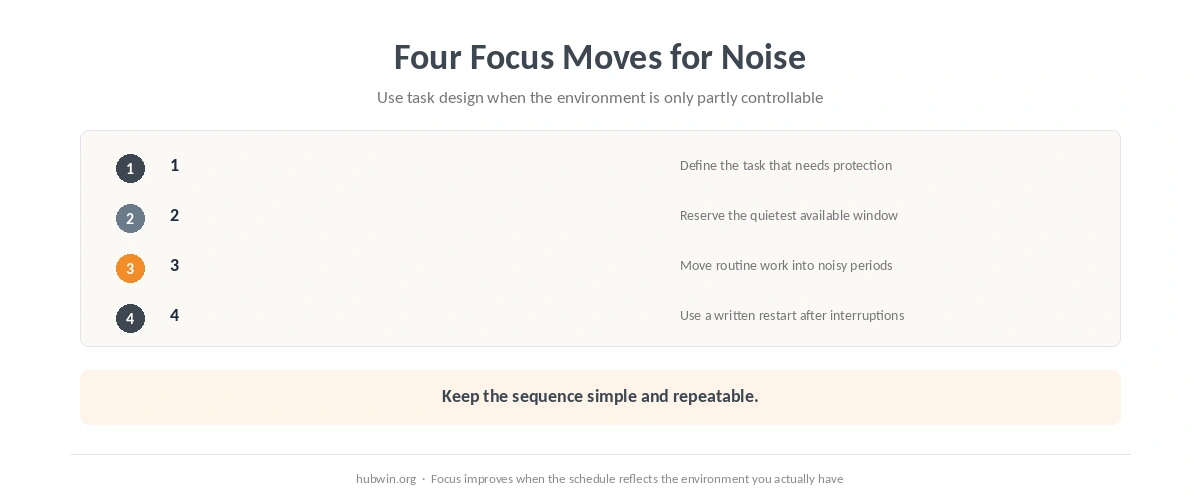
Do not try to defend the entire day. Choose one demanding task and place it in the quietest reliable window you have. This might be before the household wakes, during school hours or after a recurring noisy period ends. The deep-work guide uses the same idea. One protected block is more realistic than turning the whole day into “deep work.”
Move routine work in the opposite direction. Email triage, file naming and simple admin can often tolerate more background activity. Some calls can too. The daily schedule guide helps build those different task types into the day instead of treating every hour as interchangeable.
Focus in a Noisy Home by Separating Sound From Other Distractions
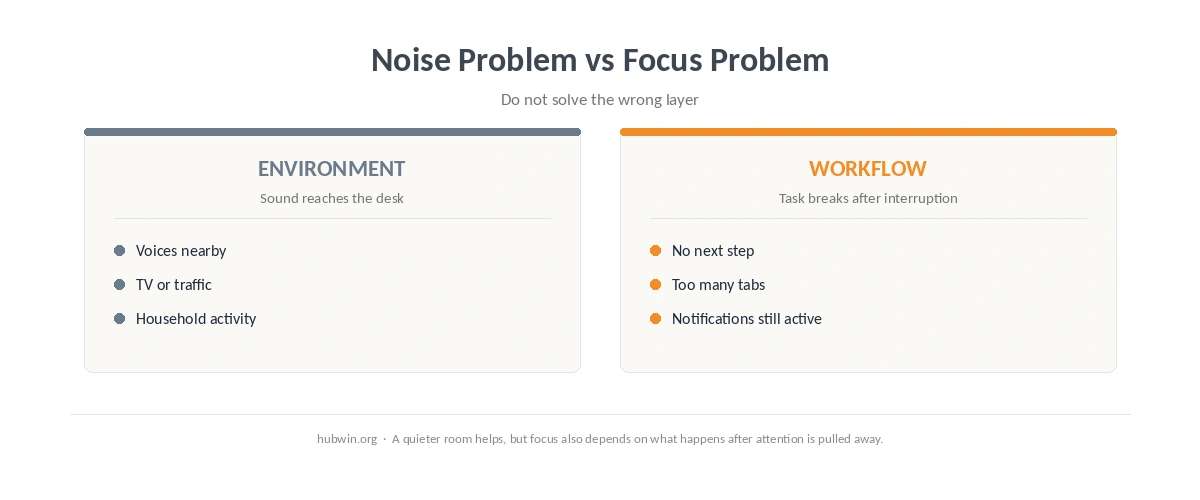
Noise is only one layer of distraction. A quiet room with constant notifications, open chats and unclear priorities can still fragment attention. Before blaming the household, close the channels you do not need. Define the next action for the task in front of you. The manage-distractions guide and distraction-free office guide cover those non-acoustic sources.
If sound itself is the main problem, change the environment rather than forcing concentration. You can improve focus in a noisy home by moving farther from speech. Use an existing door or choose another room for one focus block. The small home office guide and bedroom-office guide are useful when the quietest option is not a formal office.
Why Speech Can Break Focus Even When It Is Not Very Loud
A large body of office-noise research distinguishes intelligible speech from steady background sound. A 2019 survey included 1,078 office workers. Irrelevant speech stood out as a major noise problem and correlated with greater annoyance and lower self-reported performance. A 2022 review describes non-auditory effects of noise on cognitive workload and notes that conversations can demand extra cognitive resources. These findings come mainly from workplaces and laboratory-style tasks. They do not tell us the size of the effect for one person at home. Read the 2022 review.
The practical takeaway is modest. If voices pull your attention, prioritize separation from speech instead of treating every sound equally. The video-call setup guide can also help when your own household produces speech noise because several people are on calls.

Focus in a Noisy Home After an Interruption
When attention does break, do not restart from memory. Write the next action before leaving a demanding task, especially if interruptions are predictable. To improve focus in a noisy home after an interruption, reopen only what you need. Resume from that note. The work-from-home productivity checklist uses written anchors for the same reason, while the shutdown checklist applies the technique across days.
If a household schedule is the source of frequent interruptions, make the agreement explicit. The work-from-home-with-kids guide and work-life boundaries guide focus on shared-space expectations rather than pretending concentration is only an individual skill.
How We Research
HubWin read NIOSH’s 2020 working-from-home guidance. We also read the 2019 study of 1,078 workers and a 2022 review of noise-related cognitive workload. We also checked current NIOSH noise-control principles on distance and task relocation. HubWin rechecked the sources on October 8, 2026. Office and laboratory evidence does not give one universal home-productivity figure. We use it to shape a practical work plan rather than promise a performance gain. Read the 2019 study and see the HubWin research method.
FAQ
Protect the quietest reliable window for your hardest task. Move routine work into noisier periods and make interrupted work easy to resume.
Intelligible background speech is especially disruptive in many office-noise studies, but the effect depends on the task and the person.
No. Use the best available window and define a small, clear task that can fit inside it.
Return to a written next action rather than reconstructing the task from memory.
Scheduling cannot remove sound. It can place demanding work into periods when the environment is easier to control.
The Bottom Line
Better focus in a noisy home comes from matching the work plan to the environment. Protect one quiet block, move routine tasks into noisier periods, separate speech when possible and leave a clear restart point.