
How to create boundaries with family while working from home works better as a shared agreement than as a demand for silence. NIOSH recommends setting boundaries in both time and physical space. A 2023 qualitative study of 28 dual-income households found that families also used shared schedules, role changes, space rules and ongoing communication to manage overlapping work and home demands. Read the family boundary study.
How to Create Boundaries With Family While Working From Home: Make Them Visible
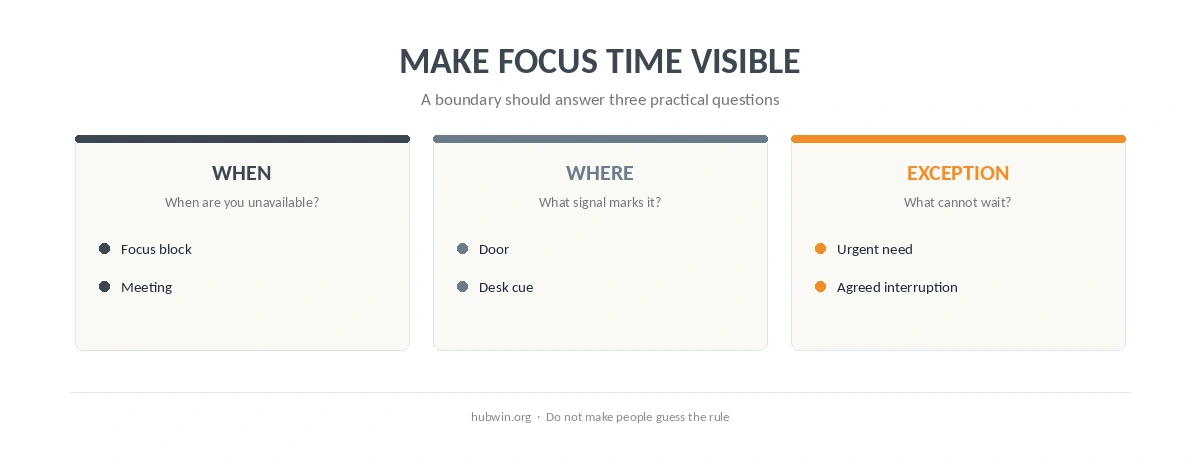
Start with signals that other people can actually use. Put focus blocks on a shared calendar. Close a door when possible, or use a simple visual cue in a shared room. Tell people when the block ends. NIOSH recommends communicating schedule information with family when work patterns affect availability. The shared-room guide gives practical space options when a door is not available.
A realistic answer to how to create boundaries with family while working from home also includes exceptions. Decide what deserves an interruption. A child who needs immediate help is different from a routine question that can wait ten minutes. Clear exceptions make boundaries easier to respect because nobody has to guess whether the rule is absolute. The home video-call setup guide helps when scheduled calls need a clearer household signal.
How to Create Boundaries With Family While Working From Home Without Creating Conflict
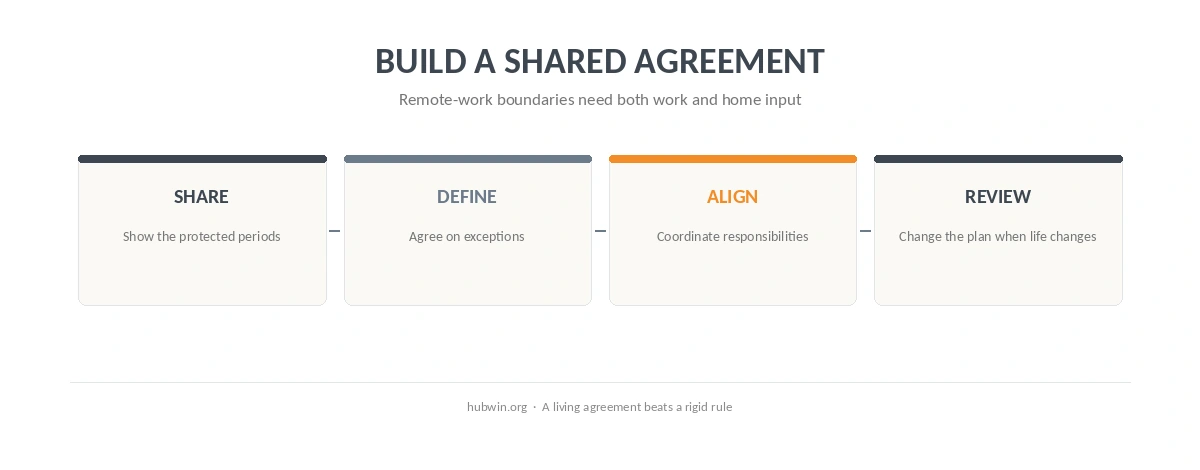
Make the agreement two-way. Work should not occupy every room or every hour simply because the laptop is available. NIOSH’s work-from-home guidance recommends boundaries between work and home life and detaching at the end of the day. The work-life boundaries guide and shutdown routine help protect the family side of the agreement too.
When you decide how to create boundaries with family while working from home, align them with the household’s real schedule. The 2023 family study identified schedule alignment, reassigning responsibilities and live boundary agreements among the strategies households used. That means the system may need to change when school, care, meetings or another person’s work hours change. The apartment setup guide also helps when several activities compete for the same physical area.
- Share the work periods that genuinely need protection.
- Use one visible signal for “interrupt only if needed.”
- Agree on what counts as a reasonable interruption.
- Put fixed family responsibilities on the same calendar.
- Create short windows when routine questions can be handled.
- Revisit the agreement when schedules or responsibilities change.
Use Space, Time and Communication Together
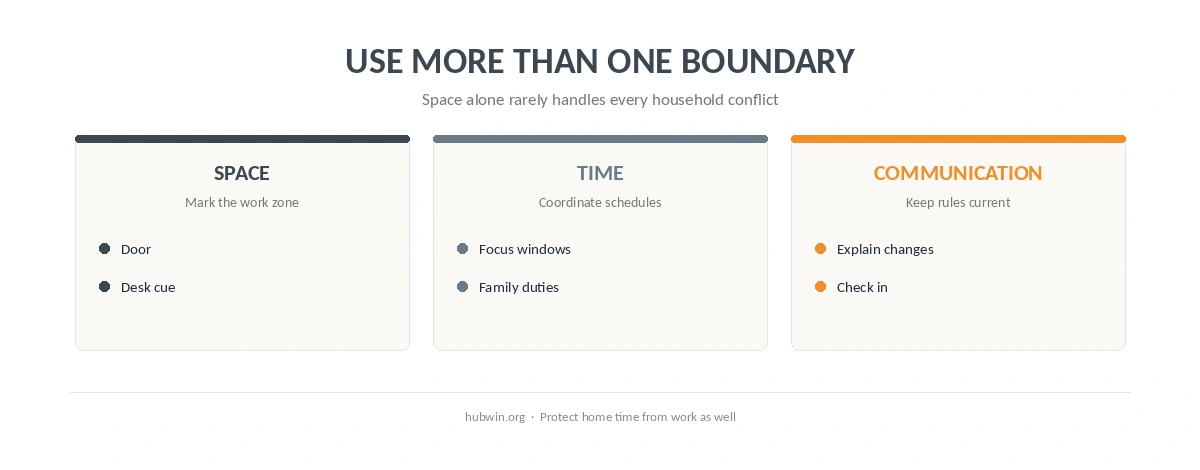
A dedicated room can help, but it is not the only boundary. If meetings create most of the conflict, the video-call guide can make those periods easier for the household to predict. The 2023 study found that households repurposed space, aligned schedules and increased communication. If several people work or study at home, combine those tools instead of expecting one closed door to solve every conflict.
For parents, the working-from-home-with-kids guide focuses on predictability rather than uninterrupted perfection. For noisy households, use the noisy-home focus guide. If interruptions remain the main problem, the distraction-management guide separates household interruptions from digital ones.
How We Research
HubWin read NIOSH work-from-home guidance and NIOSH schedule-communication guidance, plus the 2023 peer-reviewed study of 28 dual-income households with school-age children across five countries. The household study was qualitative, so it describes strategies families used rather than proving one universal method. Read the NIOSH guidance. Learn how HubWin researches articles.
FAQ
No. Agree on the situations that deserve an interruption and the questions that can wait until a planned break.
Use time, visual signals and shared schedules. A physical door is helpful, but it is only one type of boundary.
Use simple, visible rules and short predictable blocks that fit the child’s age and supervision needs.
Coordinate meetings and focus blocks, divide shared responsibilities and revisit the plan when either schedule changes.
Yes. NIOSH recommends boundaries between work and home life and detaching at the end of the day. A related productivity guide covers overworking from home.
The Bottom Line
The practical answer to how to create boundaries with family while working from home is to make the rules visible, mutual and adjustable. Share focus times, define reasonable exceptions and protect family time from work too. Boundaries work better when the whole household can understand them.