Learning how to handle interruptions at home starts with accepting that some interruptions are real and necessary. The useful strategy is to reduce avoidable signals, make household rules visible, and leave yourself a restart cue when you must stop. In a 2008 experiment, interrupted workers finished the assigned task faster but reported more stress, frustration, time pressure and effort. A related productivity guide covers Pomodoro Technique.
How to Handle Interruptions at Home: Separate Avoidable From Necessary
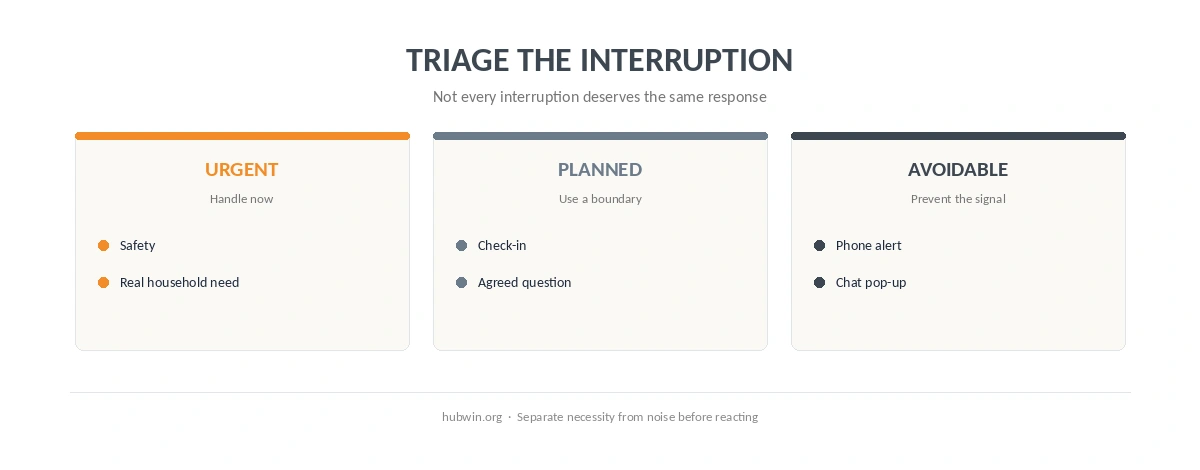
Start with interruptions you can prevent. Phone alerts, chat pop-ups and non-urgent household questions do not need the same response as a child who needs help or a real emergency. The distraction-management guide covers controllable signals, while creating a distraction-resistant office focuses on the environment.
Notifications deserve their own rule. Stothart, Mitchum and Yehnert’s 2015 experiment found that phone notifications alone disrupted performance on an attention-demanding task even when participants did not interact with the phone. Therefore, “I will ignore it” is not the same as preventing the alert. During a protected block, silence or route non-urgent notifications instead of relying only on self-control.
How to Handle Interruptions at Home When You Must Stop
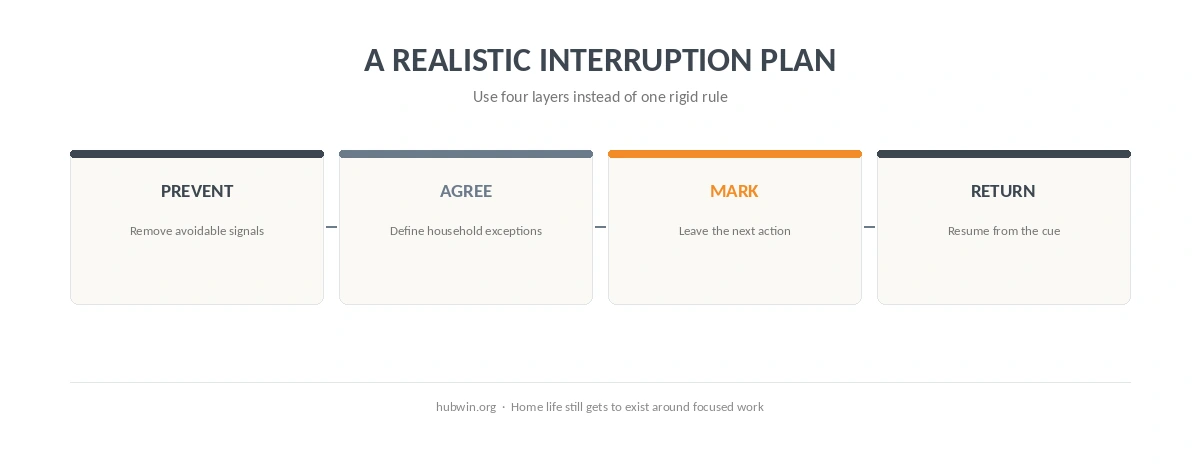
A practical part of how to handle interruptions at home is leaving a restart marker when you must stop. When an interruption is necessary, leave a restart marker before switching away. Write the next concrete action, the sentence you were about to draft, or the decision you still need to make. This is a practical response to Sophie Leroy’s 2009 attention-residue experiments, which found that thoughts about unfinished work can carry into the next task.
Keep that marker short. A restart note should reduce reconstruction, not become a second planning session. The focus guide and deep-work guide use the same principle: make the work state easy to recover after attention moves elsewhere.
| Interruption | Before you switch | When you return |
|---|---|---|
| Urgent household need | Write the next work action if there is time | Resume from that action rather than rereading everything |
| Planned question or check-in | Finish a natural stopping point | Restart from the next defined step |
| Phone or chat alert | Prevent or batch it when possible | Do not reopen every channel at once |
| Repeated non-urgent interruption | Agree on a visible rule | Review whether the rule is realistic for the household |

Use Household Boundaries for Repeated Interruptions
Another part of how to handle interruptions at home is solving repeated patterns instead of renegotiating them every time. If the same interruption repeats, solve the pattern rather than negotiating it every time. The family-boundaries guide recommends visible focus windows and agreed exceptions. The working with kids guide and shared-room guide adapt that idea when other people need the same space.
Also avoid making every interruption a productivity failure. A home office is not a laboratory. The goal is to protect work that needs continuity while leaving room for real life. The better-breaks guide can help you separate a deliberate pause from an unplanned derailment, while the calm home-office guide reduces background friction.
How We Research
HubWin read Mark, Gudith and Klocke’s 2008 interruption experiment, Leroy’s 2009 attention-residue experiments, and Stothart, Mitchum and Yehnert’s 2015 notification experiment. We rechecked the sources on October 8, 2026. These studies do not prove one perfect home routine; they explain why interruptions and task transitions deserve deliberate handling. Learn how HubWin researches articles.
FAQ
Reduce avoidable alerts, agree on clear household exceptions, and leave a short restart cue when you must switch away.
A 2015 experiment found that notifications alone disrupted performance on an attention-demanding task.
One concrete next action is enough: the next sentence, decision, file, or step you were about to use.
No. The rule needs explicit exceptions for urgent or agreed needs. The aim is clarity, not isolation.
Look for the repeated source. Some need environmental changes, some need household scheduling, and some need changes in notification settings or work planning.
The Bottom Line
The practical answer to how to handle interruptions at home is not “never get interrupted.” Reduce the signals you can control, define exceptions with other people, and leave a restart cue when you must stop. The work-from-home productivity checklist can help turn those rules into a repeatable day.