
This article is general information, not medical advice. If pain is severe, lasting or getting worse, talk to a doctor. Read our health disclaimer.
Do plants clean office air? In sealed laboratory chambers, some plants and their growing media can remove certain volatile organic compounds over time. However, that does not mean a few houseplants can clean a normal home office at a rate that competes with ordinary air exchange. A 2020 review translated plant-chamber results into clean-air delivery rates and found the practical effect was far too small for typical buildings.
That does not make plants pointless. They can still be part of a pleasant calm home-office environment or a visual preference. The narrower claim here is about air cleaning. A decoration benefit and an indoor-air-quality intervention are different questions.
Do Plants Clean Office Air? The Short Answer
Plants clean office air in some tightly controlled chamber experiments. However, ordinary potted plants are not an effective substitute for source control, ventilation, or filtration in a real room. Cummings and Waring reviewed 12 chamber-study papers and converted 196 results to a common clean-air delivery metric. Their 2020 paper estimated that roughly 10 to 1,000 plants per square meter of floor space would be needed to match the VOC removal already provided by typical building air exchange.
The key issue is scale. A sealed chamber can reveal slow pollutant removal because little fresh air enters. A home office is larger and has changing pollutant sources. It also exchanges air through leaks, ventilation, or both. Therefore, a measurable chamber effect can still be negligible in an occupied room.
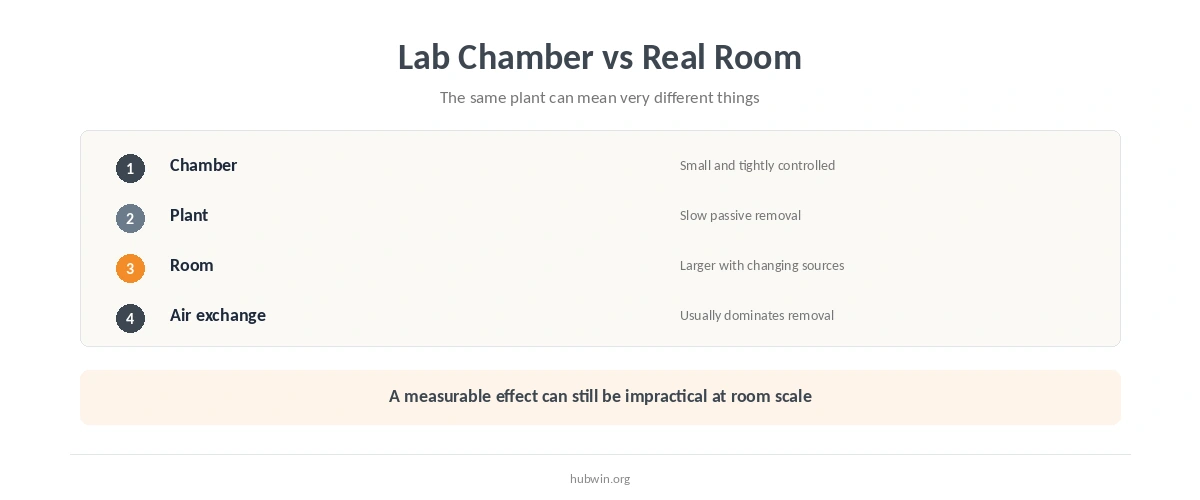
Why Plants Clean Office Air in Lab Tests but Not Enough in Rooms
The original plant-cleaning story is often linked to NASA-supported research on plants and indoor pollutants. Those experiments were useful for studying removal mechanisms in enclosed conditions. The problem came later, when chamber results were generalized into advice that one or two plants could meaningfully purify a home or office.
Cummings and Waring addressed that translation problem directly. They converted reported removal to clean-air delivery rate instead of asking only whether a plant removed any VOC. The median single-plant rate in their review was 0.023 cubic meters per hour. Their conclusion was not that plants absorb nothing. Passive potted plants were simply too slow to make a practical difference to indoor VOC loads under normal building conditions.
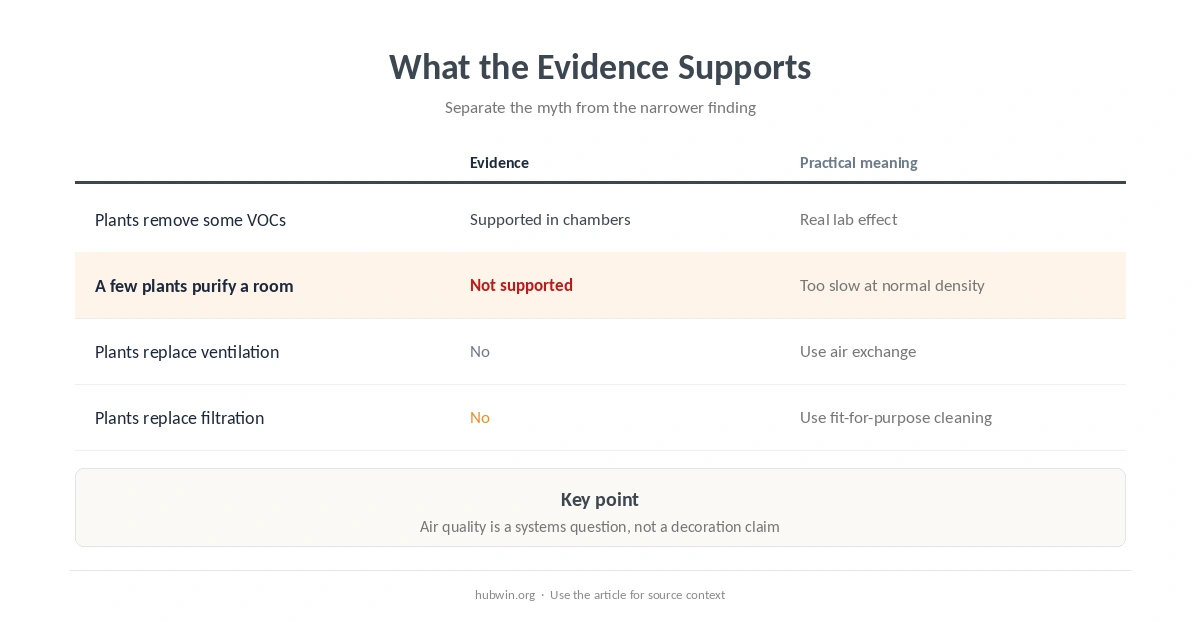
| Claim | What the evidence supports | Practical meaning |
|---|---|---|
| A plant can remove some VOCs | Yes, in many sealed-chamber studies | A measurable lab effect can be real |
| One or two plants purify a room | Not supported by the 2020 review | Removal is too slow at ordinary plant density |
| Plants replace ventilation | No | Air exchange usually removes VOCs much faster |
| Plants replace filtration | No | Use air cleaning when it matches the pollutant problem |
| Plants can still belong in an office | Yes | Keep them for preference, not as a purifier claim |
If you are changing the room itself, think about the whole environment rather than one object. Home-office lighting, screen glare, and noise control affect how the space functions even though they are not air-cleaning strategies.
What Actually Improves Indoor Air Quality
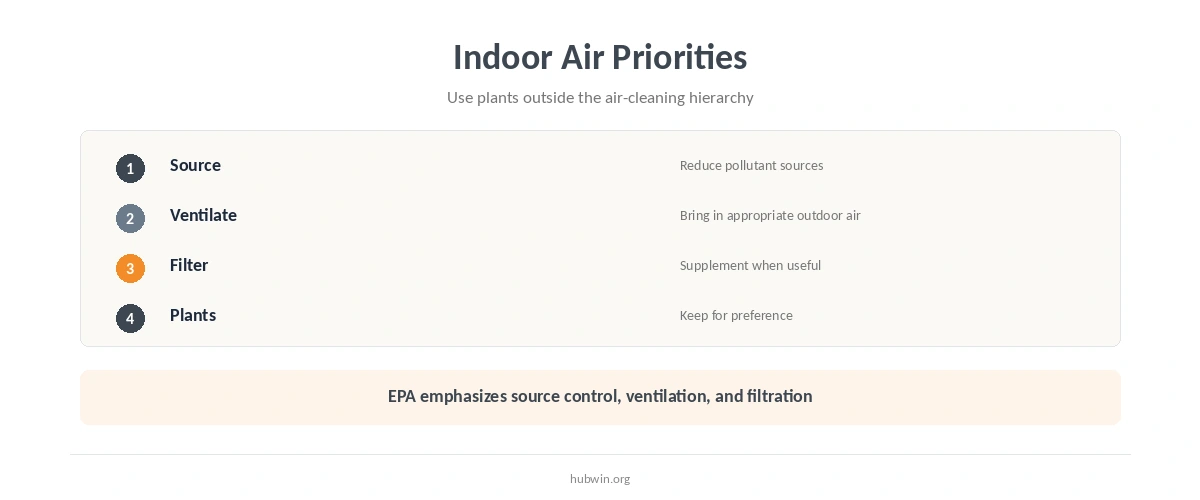
The U.S. Environmental Protection Agency groups indoor-air improvement into three basic strategies: source control, improved ventilation, and air cleaning or filtration. EPA says source control is usually the most effective approach for many indoor-air problems. Ventilation can lower pollutant concentrations when outdoor conditions allow. Filtration can supplement those measures.
The right action depends on the actual pollutant. A plant is not a general-purpose answer for moisture, smoke, particles, radon, combustion pollutants, or a strong indoor emission source. If you suspect a specific air-quality problem, identify that problem first rather than assuming that greenery will solve it.
The claim that plants clean office air becomes misleading when it skips this comparison with source control, ventilation, and filtration.
The same principle applies to office setup more broadly. A minimal home office does not need decorative additions to be functional, while an essential home-office setup should prioritize what supports the work. If plants make the room easier to enjoy, that can be enough reason to keep them.
Plants, Focus, and Well-Being Are Separate Questions
The 2020 review noted that future research could examine biophilic productivity and well-being effects separately from passive air cleaning. That distinction matters. A study about mood or preference would not prove VOC removal. Likewise, a VOC chamber study would not prove better focus.
If your goal is a room that feels less visually busy, start with decluttering the home office or an easy-to-maintain setup.
In a small room, use the small home-office setup guide. For apartment constraints, compare that with home offices in apartments.
For rooms used for both work and sleep, setting up a home office in a bedroom may matter more to the workflow than adding an air-cleaning claim to a plant. Likewise, if the real goal is focus, use the environmental changes in focusing better in a home office rather than treating a plant as a productivity device.
How We Research
HubWin separates laboratory effects from real-room performance. We read the Cummings and Waring review and current U.S. EPA indoor-air guidance on October 9, 2026. Read the 2020 potted-plant review on PubMed and the EPA guide to improving indoor air quality. See How HubWin researches articles for our source model.
Plants Clean Office Air: Common Questions
NASA-supported chamber research showed pollutant removal under enclosed test conditions. It did not show that a few plants can purify an ordinary occupied room.
The 2020 review estimated roughly 10 to 1,000 plants per square meter of floor area, depending on the reported plant-cleaning rate.
Not because of this evidence. Keep plants if you like them; just do not rely on them as the main air-quality strategy.
EPA emphasizes source control, ventilation, and appropriate filtration or air cleaning.
Possibly, but that is a different research question from whether they materially remove indoor pollutants.
So, do plants clean office air? They can remove some pollutants in laboratory conditions, but normal potted-plant density is far too low to replace proven indoor-air strategies. Treat plants as plants. Use source control, ventilation, and appropriate filtration for air quality.