How to end the workday when your office is home is mostly a boundary problem, not a motivation problem. NIOSH’s 2020 telework guidance explicitly recommends setting boundaries between work and home and detaching at the end of the day. Research on work recovery also links psychological detachment during nonwork time with better recovery-related outcomes. A useful shutdown therefore creates closure without turning the last part of the day into another productivity project. Read the NIOSH guidance.
How to End the Workday When Your Office Is Home: Close the Open Loops
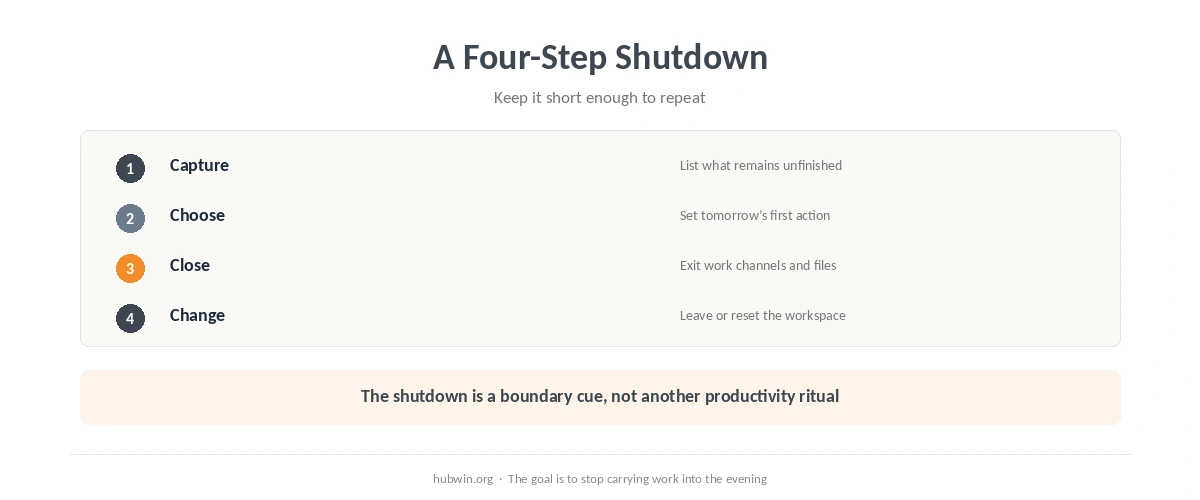
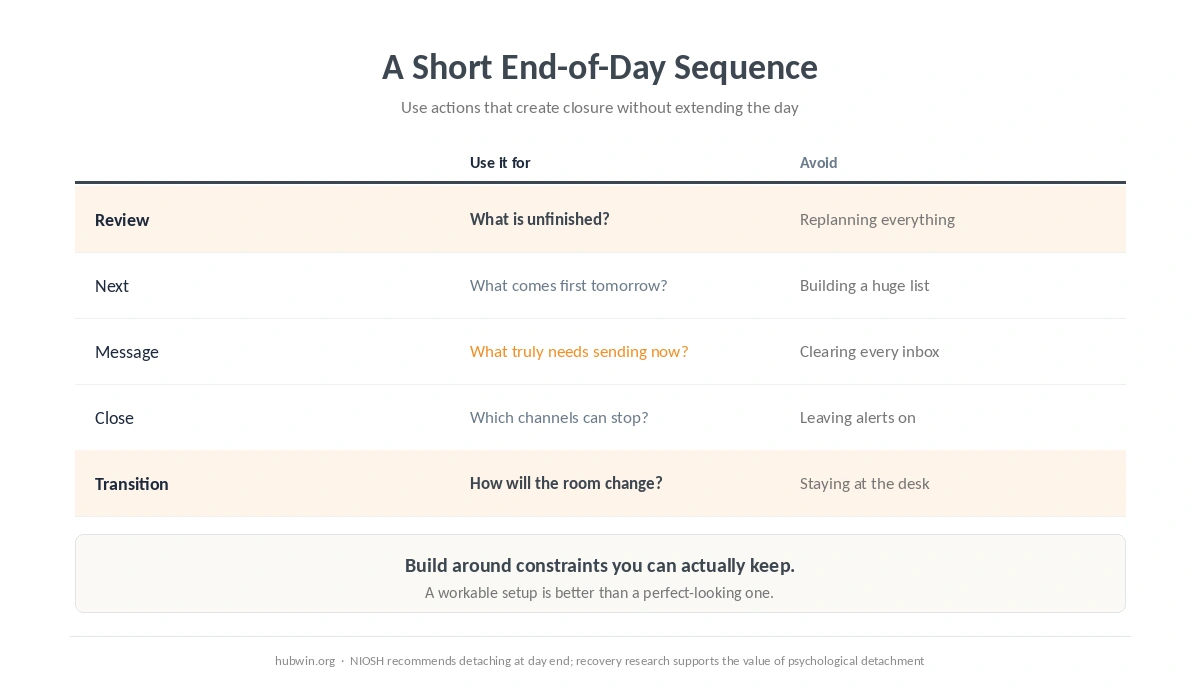
Before you stop, write down what is still unfinished and choose the first useful action for tomorrow. This is not the same as clearing every task. Research on unfinished work shows that open tasks can make psychological detachment harder. A short capture step gives unfinished work a defined place. You do not have to keep rehearsing it during the evening.
Keep the list deliberately small. Record the unfinished item, its next action and anything that must happen before you can continue. Then stop planning. If you need a fuller daytime structure, the work-from-home productivity checklist keeps the day organized without turning shutdown into another planning session. This is one practical answer to how to end the workday when your office is home: give unfinished work a next step, then stop.
Use Technology to End the Workday When Your Office Is Home
A 2011 study linked communication-technology use at home with psychological detachment. It also linked stronger segmentation preferences and norms with better detachment. The practical lesson is modest: if a channel does not need to stay active after work, close it. Leave only the route that your role genuinely requires for on-call or emergency coverage. Read the work-home segmentation study.
Turn off routine work notifications, close the work browser profile, and put the laptop away if the room has another purpose. If the computer must stay visible, change the environment in another obvious way: clear the work materials, switch lighting, leave the desk or move to a different seat. The work-life boundaries guide gives more options for shared rooms. The distraction-free office guide can help make the same space look and feel different after work.

How to End the Workday When Your Office Is Home Without Adding Another Ritual
A 2021 meta-analysis reviewed 30 studies with 34 interventions and 3,725 participants designed to improve psychological detachment from work. The evidence suggests that deliberate interventions can improve detachment. It does not justify a complicated ritual for everyone. When your office is home, the workday can end with a few repeatable actions rather than a long checklist. Your shutdown should take only as long as needed to capture the work and create a boundary. See the 2021 meta-analysis. The distraction-management guide covers attention during the workday.
If the workday is routinely spilling hours past the planned stop, the problem may be workload rather than the shutdown routine. The work-from-home burnout guide separates individual routines from workload, schedules and organizational support. A better checklist cannot make unlimited work finite. The productivity-without-hacks guide also separates a workable routine from simply extending the day.
Make Tomorrow Easier Without Starting Tomorrow Tonight
Choose one first step for the morning, not a complete plan for every hour. Put anything you need for that step where you can find it, then leave the rest for the next work period. The morning routine guide can pick up from there. If the workspace is in a bedroom, the bedroom office guide offers physical reset ideas. The decluttering guide can make the shutdown more visible without adding furniture.
If you share the home with family or housemates, tell them the boundary you are using. A visible signal such as closing the laptop, leaving the desk or changing rooms works better when the people around you understand what it means.
How We Research
HubWin read NIOSH’s 2020 telework guidance and Park, Fritz and Jex’s 2011 work-home segmentation study. We also read a 2021 meta-analysis of interventions to improve psychological detachment from work. Those sources support boundary and detachment principles, not one mandatory shutdown ritual. HubWin checked them on October 8, 2026. Read the detachment meta-analysis and see the HubWin research method.
FAQ
Capture unfinished work, choose tomorrow’s first action, close nonessential work channels and create a visible change in the workspace.
No. Keep it short enough to repeat. The goal is closure and a boundary, not another optimization system.
Not unless your job specifically requires it. Capture truly urgent items and leave normal work for the next work period.
Keep the required on-call route active and close the channels that are not part of that responsibility.
It gives unfinished work a clear next action so you do not need to keep rehearsing it during nonwork time.
The Bottom Line
How to end the workday when your office is home comes down to making the stop visible: capture what remains, choose the next action, close what can close and change context. The routine should protect the evening, not consume more of it.